


“Understanding what's driving pipeline is how my team is judged.”
That's what a senior B2B marketing leader told us during a recent conversation...
And then she admitted something that made the situation considerably more uncomfortable.
Her team couldn't confidently determine which advertising investments were producing that pipeline.
They could see clicks.
They could see engagement.
They could see whether pipeline was growing.
But when it came to connecting the money they were spending on LinkedIn and other paid social channels to the business outcomes leadership cared about...
They didn't know.
And revenue?
That was an even bigger question.
“I guess we're going to find out if we're impacting revenue.”
She's accountable for generating pipeline.
Her team is judged on the results.
But the measurement available to her stops short of proving the contribution they're responsible for making.
How do you defend your team's performance when you can't connect its work to the numbers leadership uses to evaluate it?
That's a much bigger problem than having an incomplete marketing dashboard.
Because when leadership starts questioning the results, it's your team's credibility that's on the line.
The Numbers Your Team Reports Aren't The Numbers Leadership Cares About
Your media buyer walks into the weekly meeting with a campaign report.
LinkedIn engagement is up.
Click-through rates are improving.
Cost per lead is coming down.
The team has been testing creative, refining audiences and making adjustments to improve performance.
By the numbers they're watching every day, things appear to be moving in the right direction.
Then someone from leadership asks a different question.
“How much pipeline did all of this create?”
Suddenly, those impressive campaign numbers aren't quite as useful.
You know how many people clicked.
You know how many submitted a form.
You might even know how many became MQLs.
But which campaigns are contributing to qualified opportunities?
Which ones are associated with customers who actually close?
And how much of the pipeline your team is being judged on can you reasonably connect to the advertising you're running?
That's where the conversation starts getting complicated.
Because your advertising platforms are reporting one set of results.
Your CRM is reporting another.
And your attribution system may be giving most of the conversion credit to the last channel a buyer touched before entering the pipeline.
Which often means Google or organic search gets the credit.
Meanwhile, the LinkedIn campaigns you've been funding to introduce new buyers to your company are left looking like an expensive way to generate clicks.
The problem isn't that those clicks are meaningless.
It's that clicks aren't the outcome your team is being held accountable for.
And the longer that disconnect continues, the harder it becomes to explain the business value of your marketing investments.
When Pipeline Grows, You Still Have To Explain Why
The marketing leader we spoke with described how her team was trying to make sense of its results.
They looked at campaign engagement.
They watched clicks.
Then, three to six months later, they looked at pipeline.
If pipeline increased, maybe their advertising was helping.
But they couldn't confidently connect the two.
That creates an interesting problem.
Because even good news becomes difficult to explain.
Imagine pipeline increases 20% next quarter.
Leadership is happy.
Sales is happy.
And your team has been working hard to make that happen.
But then the questions start.
Which investments produced the increase?
Was it LinkedIn?
Was it paid search?
Was it the campaigns you launched three months ago?
Or would much of that pipeline have arrived anyway?
You can show that marketing was active during the period.
You can show that campaigns generated engagement.
You can show that pipeline grew.
But you can't confidently explain how those pieces fit together.
And if you can't explain what produced the increase, how do you know where to invest to produce more of it?
Now imagine the opposite.
Pipeline falls short.
Suddenly, leadership wants to know what needs to change.
Should the team increase LinkedIn spend?
Shift more budget into search?
Reduce investment in awareness?
Or reconsider the entire paid media strategy?
Without a reliable connection between advertising activity and downstream results, those decisions become difficult to defend.
You're being asked to improve a number without being able to see clearly what's moving it.
Your Attribution Can Make The Wrong Team Look Like The Hero
The channels that help create demand aren't necessarily the channels that get credit when someone converts.
Think about a potential buyer who first encounters your company through LinkedIn.
They see your advertising.
Maybe they engage with another campaign a few weeks later.
Eventually, they start researching your company more seriously.
They search for your brand on Google.
Visit the website.
Request a demo.
And months later, become a customer.
If your reporting relies heavily on last-touch attribution, Google may get the credit.
Which makes search look extremely productive.
And LinkedIn?
It may look like a channel that generates engagement without contributing much pipeline.
But that report doesn't tell you whether the buyer would have searched for your company without the earlier advertising.
Now imagine walking into a budget meeting with those numbers.
Leadership sees strong performance from search.
They see limited attributed revenue from LinkedIn.
And the natural conclusion is to put more money into the channel that appears to be producing customers.
Except you may be shifting money away from the campaigns that helped create the demand search eventually captured.
That's not simply a reporting problem.
It's a budget decision being made with an incomplete understanding of how customers are acquired.
And if your team's performance is judged on pipeline and revenue, that incomplete understanding can have real consequences.
What If You Could Walk Into The Next Leadership Meeting With The Revenue Story Already Buttoned Up?
Imagine a different conversation.
Leadership asks what marketing contributed to pipeline last quarter.
Instead of opening five dashboards and trying to reconcile the numbers...
You open Blueprint.
Your advertising platforms are connected to your downstream business results through systems such as Salesforce.
You can examine which campaigns are associated with qualified opportunities and closed-won customers.
And instead of seeing only the final channel that received attribution credit, you can investigate the marketing interactions that helped bring those buyers into the business.
Now you can start answering questions that previously required hours of manual investigation.
Which paid channels appear in the journeys of customers who close?
Which campaigns are influencing qualified opportunities?
Where is marketing contributing before the final conversion?
And which investments are showing a meaningful relationship with downstream business performance, even when a complete individual customer path isn't available?
That's the difference between reporting marketing activity and explaining marketing's contribution.
And it's where two Blueprint capabilities become particularly valuable.
Influence: See The Marketing Behind The Closed Deal
Blueprint's Influence measurement helps you examine the observable customer journey rather than relying entirely on the final conversion touchpoint.

Let's say a customer first encountered your company through LinkedIn.
Later engaged with another paid campaign.
Then returned through Google before requesting a demo.
The opportunity moved through your sales process.
And eventually closed.
Instead of giving all the attention to the last click, Influence helps reveal the earlier marketing interactions that contributed to that journey.
Now you can examine the channels and campaigns associated with the opportunities your sales team is converting.
That's important because leadership doesn't just want to know how many people marketing attracted.
They want to know whether those people are becoming valuable customers.
And when you can connect advertising interactions to downstream CRM outcomes, you have a much more useful way to evaluate marketing performance.
But there's still a problem.
Not every advertising channel produces a customer journey you can reconstruct.
Which brings us to the second piece.
Impact: Put Numbers Behind The Channels Attribution Struggles To Measure
Blueprint's Impact provides another way to evaluate advertising contribution.
Instead of requiring a direct click path from an ad to a customer, Impact examines how changes in advertising investment relate to changes in downstream business outcomes.
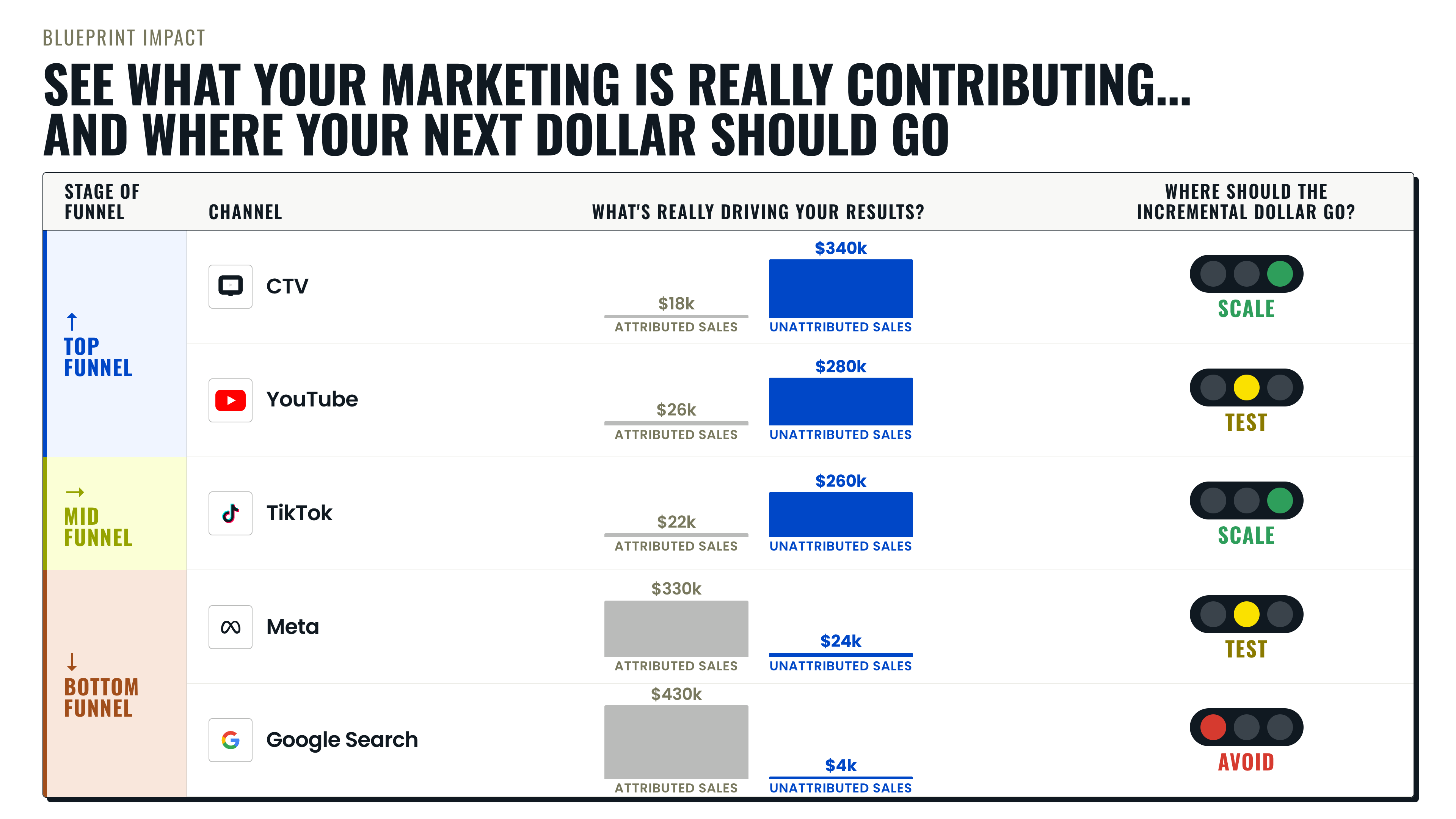
That matters for top-of-funnel channels whose effects may appear later, or whose contributions aren't fully captured through individual customer interactions.
Think about the LinkedIn investment that receives little last-touch credit.
Impact gives you a way to examine whether changes in that investment show a meaningful statistical relationship with qualified pipeline or closed-won revenue, where those outcomes are supported by the connected data.
And because the analysis is designed to update continuously, you don't have to rely entirely on another isolated study every time leadership wants an answer.
You can look at attribution.
You can examine Influence.
And you can evaluate the additional relationships Impact is revealing.
Together, those views help you build a more complete explanation of how your advertising investments relate to business results.
You now have more evidence to work with than clicks, engagement and a hopeful explanation about pipeline growth.
You're finally measuring marketing against the outcomes leadership is using to judge your team.
Get Updates Like This Monthly
Join our Mailing List
Blueprint Advertising Machine needs the contact information you provide to us to contact you about our products and services. You may unsubscribe from these communications at any time. For information on how to unsubscribe, as well as our privacy practices and commitment to protecting your privacy, please review our Privacy Policy.
The Budget Conversation Changes When You Can Connect Marketing To Revenue
Once you can evaluate marketing against qualified pipeline and closed-won revenue, the conversation starts moving beyond defending last quarter's results.
You can start making a stronger case for what happens next.
Imagine leadership asks whether your team needs another $500,000 in advertising budget.
Normally, you might show how many additional impressions, clicks or leads that investment could generate.
But those aren't necessarily the outcomes leadership wants to buy.
They want pipeline.
And ultimately, customers.
Now imagine being able to show which campaigns are associated with your strongest downstream results.
Which channels are helping introduce buyers who eventually close.
And where the evidence suggests additional investment may still have room to produce meaningful business outcomes.
That's a much more compelling budget conversation.
You're not simply asking leadership to trust that more advertising activity will eventually produce more pipeline.
You're showing them the evidence behind your recommendation.
And just as importantly, you're giving them a clearer way to evaluate whether that investment is working over time.
Because the real goal isn't to produce a better-looking report.
It's to make better decisions about how the company acquires customers.
And when those decisions are tied to the same business outcomes leadership cares about, your team's contribution becomes much easier to explain.
Stop Making Your Team's Value Depend On The Last Click
“Understanding what's driving pipeline is how my team is judged.”
And revenue was even more important.
She understood exactly what leadership expected from her team.
The problem was that her measurement couldn't give her the evidence she needed to connect her team's work to those expectations.
That's an uncomfortable place to be.
Because even when marketing is contributing to growth, incomplete reporting can make that contribution difficult to demonstrate.
And when performance comes under scrutiny, the channels that are easiest to measure can start looking like the only ones worth funding.
Meanwhile, the campaigns helping create tomorrow's demand may be the first ones questioned.
It doesn't have to work that way.
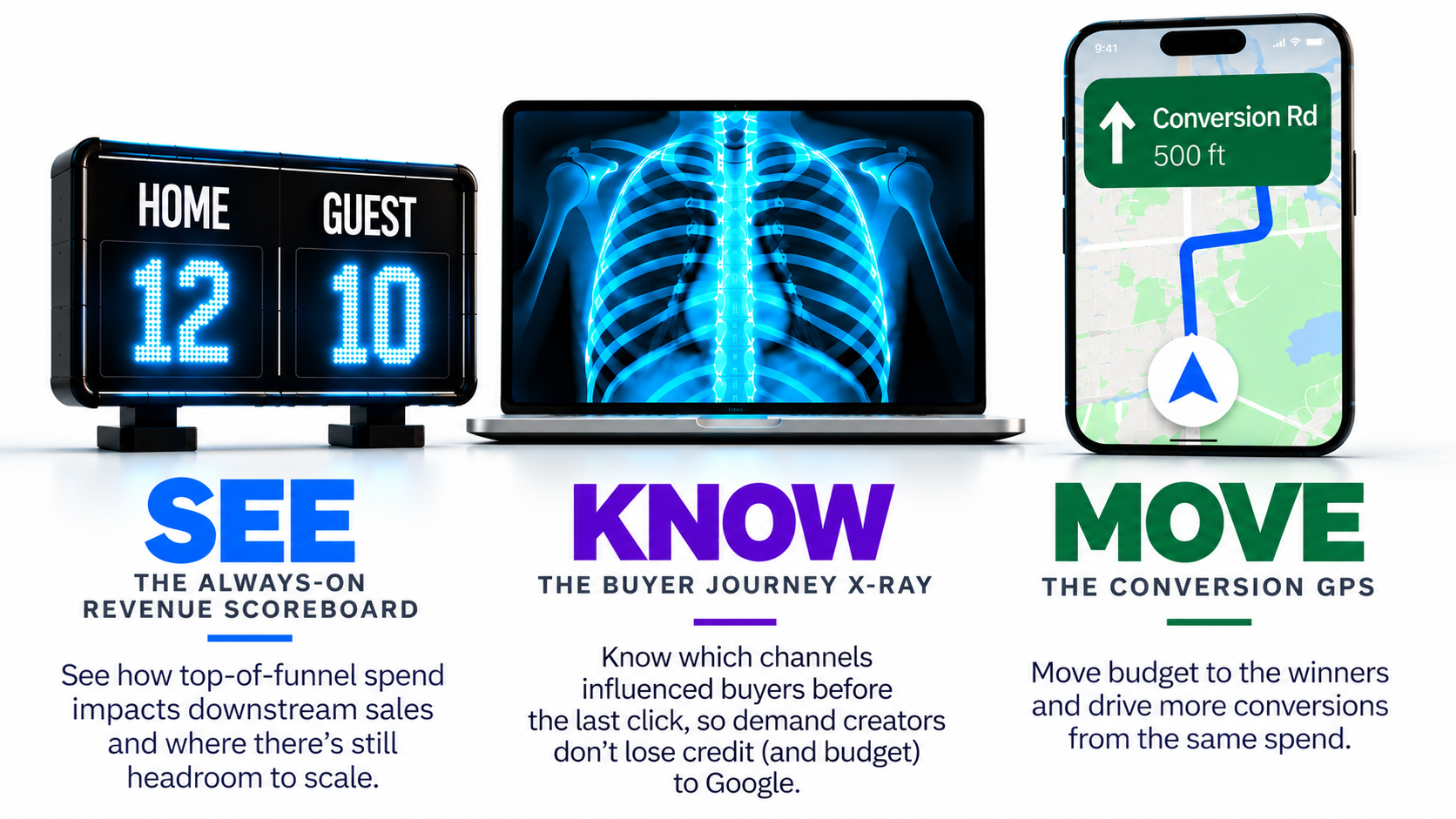
You should be able to see how your advertising investments relate to downstream results.
Understand the marketing journeys behind the opportunities your sales team is closing.
And make budget recommendations using evidence that extends beyond clicks and leads.
Because when leadership asks what your team contributed to revenue...
You deserve to have something more compelling to show them than a report full of clicks.
FAQ
How can B2B marketing teams prove their contribution to revenue?
B2B marketing teams can connect advertising performance data with CRM outcomes such as qualified opportunities and closed-won revenue. By examining observable customer journeys alongside channel-level impact measurements, marketers can build a more complete picture of how their investments contribute to business results.
Why do marketing dashboards focus on clicks when leadership cares about pipeline?
Advertising platforms primarily report activity and conversions observable within their own systems. Leadership, however, evaluates marketing based on downstream outcomes such as pipeline and revenue. Connecting advertising platforms with CRM data helps bridge the gap between campaign reporting and business performance.
How does Blueprint connect advertising to Salesforce revenue?
Blueprint integrates advertising and analytics data with CRM information, including Salesforce, to help marketers examine marketing activity alongside downstream opportunity and revenue outcomes. This supports analysis of which campaigns and channels are associated with qualified pipeline and closed-won customers.
What's the difference between Blueprint Influence and Impact?
Influence examines observable marketing touchpoints across customer journeys, helping marketers understand which interactions contributed before a conversion. Impact evaluates statistical relationships between changes in advertising spend and changes in downstream business results. Together, they provide complementary evidence about marketing contribution.
Can marketing prove that every closed-won deal was caused by advertising?
No. Individual attribution and statistical impact measurement have limitations. Not every customer interaction is observable, and statistical relationships don't automatically establish causation. Combining different measurement approaches can nevertheless provide a more complete and defensible view of marketing's contribution to business outcomes.