


“Maybe we're doing something right...”
Pipeline would increase three to six months after their campaigns had been running.
Good news, right?
Except nobody could confidently explain which advertising decisions had contributed to that growth.
And in the meantime, the team had been spending money every single day.
Testing creative. Adjusting campaigns. Investing heavily in LinkedIn while experimenting with Meta and Reddit.
All without knowing which decisions were actually helping create the business outcomes they cared about.
Three to six months of spending... And the best they could say was “maybe.”
The Most Expensive Part Isn't Waiting Three Months
When we asked this marketing leader how her team determined which advertising campaigns were working, her answer was revealing.
Her team could look inside LinkedIn and see whether an ad was generating engagement or clicks.
But beyond that?
They didn't know.
“We just think, okay, well we see an increase in pipeline like three to six months down the line. Maybe we're doing something right. But that's it.”
And because their campaigns were always running, it was difficult to isolate which advertising decisions contributed to the results.
Now, there's nothing unusual about a B2B sales cycle taking several months.
The problem is what happens during those months.
Imagine you're spending $200,000 a month on acquisition.
That's $600,000 over three months.
Or $1.2 million over six.
Throughout that period, your team is making decisions about where the money goes.
Which audiences deserve more budget?
Which campaigns should be scaled?
Which creatives are attracting the right buyers?
Should you invest more in LinkedIn or start moving money toward Meta, Reddit, or another channel?
You have decisions to make today.
But the business outcomes you're using to evaluate those decisions may not become visible until months later.
And when they finally arrive, you still may not know which investments contributed.
You're spending money while waiting to learn what to do with the money.
That's a very expensive way to run an acquisition program.
And it's especially frustrating when the business is growing.
Because even when pipeline increases, you may have no reliable way to determine which campaigns deserve more investment.
Which means your next budget decision can end up being another educated guess.
It's the same acquisition ceiling that prevents otherwise successful marketing programs from scaling.
Your Campaigns Are Always On... Your Measurement Isn't.
Most established B2B marketing teams aren't running one campaign, stopping everything, and waiting three months to see what happens.
They're running multiple campaigns simultaneously.
LinkedIn is generating impressions and engagement.
Paid search is capturing existing demand.
New creative is being introduced.
Audiences are being adjusted.
Budgets are moving between campaigns.
And somewhere in the background, opportunities are progressing through the sales pipeline.
Then, three months later, pipeline increases.
Great.
Which decision produced that increase?
Was it the LinkedIn campaign you scaled in January?
The new creative you launched in February?
The prospects who first encountered your company months before either campaign?
Or a combination of marketing activities and other factors?
When everything is running continuously, it's difficult to separate one decision from another.
And the longer the sales cycle, the more activity gets layered into the picture.
This is why simply waiting for pipeline reporting doesn't solve the measurement problem.
Pipeline tells you what happened to the business. It doesn't automatically tell you which marketing decisions helped make it happen.
Yet many teams are effectively using it that way.
They spend.
They watch engagement.
They wait for pipeline.
Then they try to connect the dots after the fact.
And the next quarter starts with many of the same unanswered questions.
Even worse, the channels getting credit may be the ones capturing demand rather than creating it.
Meanwhile, The Opportunities Keep Coming And Going
Think about what happens when you discover a campaign that's performing unusually well.
Maybe a new LinkedIn audience is generating stronger engagement.
Maybe a particular message is resonating.
Maybe another channel is starting to produce more qualified prospects.
Those signals are worth investigating.
But engagement alone doesn't tell you whether the people responding are likely to become customers.
So what do you do?
Increase the budget and hope?
Leave it alone until the pipeline data catches up?
Or shift money toward a campaign with more immediately visible conversions, even if those conversions aren't the best predictor of downstream revenue?
You may have a genuine opportunity to accelerate growth.
But without reliable measurement connecting your advertising to the outcomes that matter, you can't confidently decide how much money to put behind it.
And opportunities don't necessarily wait for your next quarterly review.
A campaign can lose momentum.
An audience can become saturated.
Creative can fatigue.
A competitor can move aggressively into the same market.
By the time you've gathered enough information to feel comfortable making a decision, the opportunity may look very different.
It's a familiar problem for teams whose marketing measurement takes weeks while budget decisions need to happen now.
The advantage goes to the team that can recognize meaningful performance changes and respond while there's still something to gain.
Not the team with the prettiest report three months after the fact.
What would your acquisition program look like if you didn't have to operate this way?
What If We Took The Measurement And Optimization Problem Off Your Plate?
Imagine setting your acquisition budget and having an always-on system working alongside your team.
One that connects your advertising investments to the business outcomes you care about.
Continuously evaluates the evidence coming in.
And helps identify where your next advertising dollar may produce a better result.
Instead of spending three to six months waiting to find out whether your strategy worked, you're making informed adjustments throughout that period.
That's what we've built Blueprint to help marketing teams do.
And it starts with three steps.
Step 1: We Connect Your Advertising To The Business Results That Actually Matter
First, we establish the measurement foundation.
We connect your existing advertising platforms, GA4, and downstream systems such as Salesforce.
For a B2B company, that means connecting advertising activity with the events that matter throughout the sales process.
A lead becomes an MQL.
An MQL becomes a sales-qualified opportunity.
An opportunity eventually becomes a customer.
The important part is that those outcomes are no longer sitting in completely separate reporting systems.
And because tracking isn't always configured correctly, our team also helps identify and address measurement problems.
Disconnected sessions.
Cross-domain tracking gaps.
Events that aren't being captured or connected properly.
We work through the measurement plumbing so the system has a reliable foundation.
And you don't have to become the person responsible for stitching together five different reports every time leadership asks what's working.
Now we can start answering a much more valuable question.
What is your advertising contributing to the outcomes the business actually cares about?
Step 2: We Continuously Measure What's Working, Including The Channels That Don't Get The Credit
Once the data is connected, Blueprint gives you complementary ways to understand advertising performance.
Influence helps reveal the observable marketing interactions that occurred before someone converted.

So if a buyer encountered your LinkedIn advertising before eventually returning through Google and becoming a qualified opportunity, you can examine those earlier interactions rather than giving all the attention to the final click.
That's important because the channel that captures demand isn't necessarily the one that helped create it.
But customer journeys don't tell the whole story either.
Some advertising contributes to business outcomes without leaving a complete, observable click path.
That's where Impact comes in.
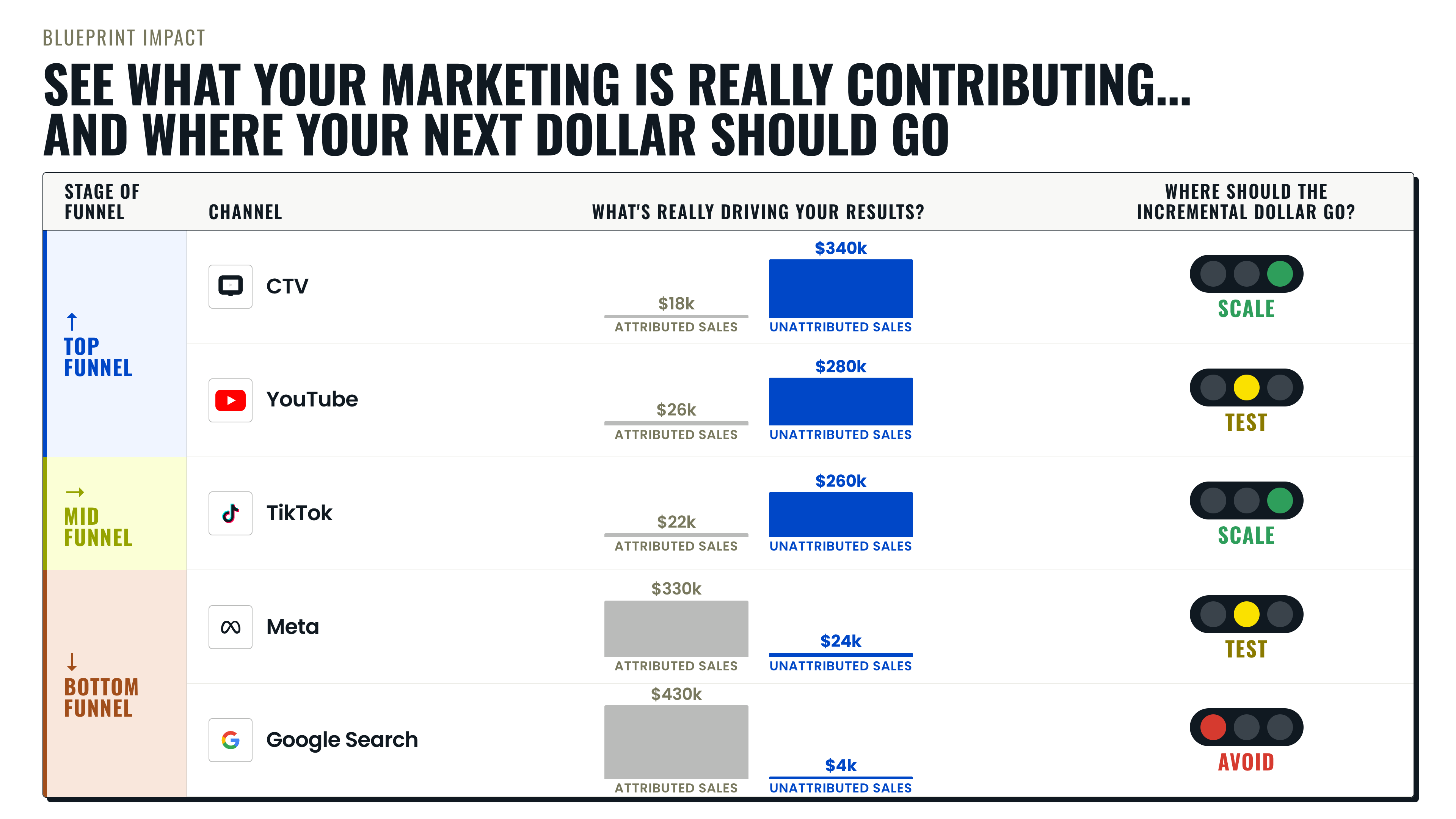
Impact examines the statistical relationship between changes in advertising investment and changes in downstream outcomes, where sufficient data is available.
Instead of relying exclusively on last-touch attribution, you can evaluate whether changes in spending across channels are associated with meaningful changes in business performance.
And because the measurement is designed to update continuously, you're not dependent on commissioning another isolated analysis every time you need to revisit the question.
You're developing an ongoing view of advertising performance as new evidence becomes available.
Now, this doesn't mean a three-month sales cycle suddenly becomes a three-day sales cycle.
And it doesn't mean every campaign's incremental revenue contribution can be proven overnight.
But it does mean you're no longer restricted to looking at clicks today and hoping pipeline will explain everything months later.
You can use the observable customer journeys, the downstream outcomes already available, and the statistical relationships emerging in the data to make more informed decisions along the way.
Instead of waiting for the final result before learning anything, you're building a clearer picture as the evidence develops.
And that leads to the third step.
Get Updates Like This Monthly
Join our Mailing List
Blueprint Advertising Machine needs the contact information you provide to us to contact you about our products and services. You may unsubscribe from these communications at any time. For information on how to unsubscribe, as well as our privacy practices and commitment to protecting your privacy, please review our Privacy Policy.
Step 3: We Help You Move Budget Toward The Results You Want More Of
This is where measurement becomes particularly valuable.
Because knowing what's working is only useful if it changes what you do next.
Blueprint's Optimizer helps turn performance data into allocation recommendations.
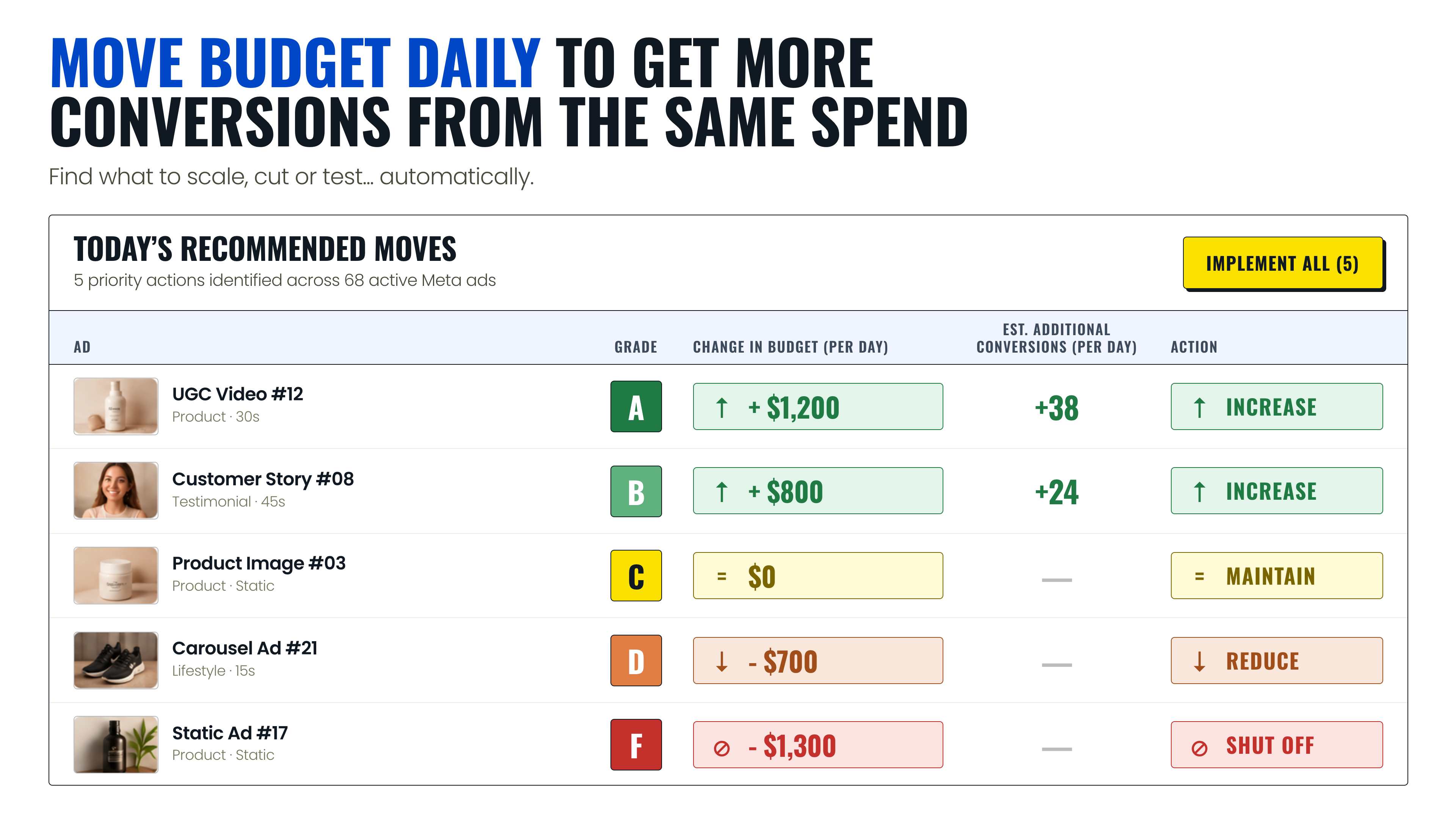
You choose the business metric you want to optimize toward, based on the outcomes available in your connected data.
Then Blueprint evaluates how your current budget is being spent and identifies opportunities to improve the allocation.
Across channels.
Within campaigns.
Down to individual ads.
Maybe one campaign is attracting more of the prospects who eventually become qualified opportunities.
Maybe another is generating plenty of engagement but showing weaker downstream results.
Maybe the evidence suggests an opportunity to shift existing budget rather than increase total spending.
Instead of making those decisions from disconnected dashboards and intuition alone, you have recommendations grounded in a more complete measurement picture.
And as new performance data arrives, you can continue evaluating and adjusting.
This is the operating advantage.
Set the objective. Measure continuously. Identify opportunities. Move the budget. Repeat.
You're no longer treating the quarterly review as the first opportunity to discover whether your acquisition strategy needs to change.
You're building an ongoing process for improving it.
And that's a fundamentally different way to manage marketing spend.
While Everyone Else Is Waiting, You're Already Making Your Next Move
Imagine two marketing teams with similar budgets.
Both are investing heavily in acquisition.
Both have experienced media buyers.
Both are running campaigns across several channels.
And both are trying to increase qualified pipeline.
The first team operates the traditional way.
They set the budget.
Launch campaigns.
Monitor engagement and leads.
And wait for downstream pipeline results.
Three months later, they review performance and try to determine what worked.
Then they begin planning the next round of changes.
The second team has connected its advertising data to downstream business outcomes and established an ongoing measurement and optimization process.
As the quarter progresses, the team can examine which campaigns are appearing in converting customer journeys, evaluate the relationship between channel investments and available business results, and identify opportunities to improve allocation.
When the evidence supports a change, they don't have to wait until the next quarterly review to consider it.
They can act.
And then keep measuring.
This is where the competitive advantage starts to emerge.
Not because every decision is guaranteed to be right.
But because one team has a system designed to support repeated, evidence-informed decisions while the other is still relying heavily on delayed results and educated guesses.
Think about what that can mean over a year.
More opportunities to identify underperforming investments.
More opportunities to shift budget toward stronger signals.
More opportunities to learn which campaigns are attracting the customers your business actually wants.
And fewer occasions where the only explanation for pipeline growth is that something you did months ago must have worked.
The ability to recognize opportunities earlier can also help you find your next growth channel before the opportunity becomes obvious.
Experience and judgment are valuable.
But imagine what happens when you give experienced marketers a measurement and optimization system that helps them act on better evidence.
They become much more capable of responding to what the market is telling them.
Your Next Leadership Meeting Looks Very Different
Now let's bring this back to the marketing leader who started our story.
Remember her description?
Pipeline increases three to six months later.
“Maybe we're doing something right.”
Imagine how that conversation sounds in a leadership meeting.
The CEO asks how the acquisition program is performing.
The marketing team explains that LinkedIn engagement has been strong.
Pipeline is increasing.
They believe the advertising is helping.
But they can't confidently explain which investments contributed or where the next dollar should go.
Now imagine that same conversation with Blueprint in place.
The CEO asks how the acquisition program is performing.
And instead of relying on a general explanation of campaign activity, the marketing leader can walk through the evidence.
Here's what we're seeing across our advertising investments.
Here's how those channels are showing up in the journeys of qualified opportunities.
Here's what the available downstream data tells us about the campaigns and channels associated with stronger business outcomes.
Here's where we're seeing opportunities to improve allocation.
And here's what we've already adjusted as a result.

Notice what's changed.
The conversation is no longer dominated by trying to reconstruct what happened three months ago.
It's about the decisions the team is making now and the evidence supporting those decisions.
Leadership has a clearer understanding of how the marketing budget is being managed.
The marketing team has a stronger basis for explaining its contribution.
And instead of leaving the meeting with another assignment to reconcile conflicting reports, the team can spend more time discussing where to invest next.
It's the difference between scrambling to assemble a report and walking into your next QBR with the marketing story already buttoned up.
Because ultimately, the business doesn't want more clicks for the sake of clicks.
It wants more qualified opportunities.
More customers.
And more confidence that its acquisition budget is being put to work intelligently.
Three To Six Months From Now, Will You Still Be Guessing?
Your pipeline may still take three to six months to develop.
That's the reality of many B2B businesses.
But your marketing decisions don't have to sit still for three to six months while you wait.
You can establish the measurement foundation.
Connect advertising to the business outcomes that matter.
Continuously evaluate the evidence as it develops.
And use that evidence to identify opportunities to improve where your budget goes.
Because the real advantage isn't simply knowing whether your pipeline increased.
It's developing a repeatable process for making better acquisition decisions before the next quarter is already over.
While other teams are waiting for their results to arrive, yours can be evaluating, learning, and making the next move.
And when leadership asks what's working?
You have something much more valuable to say than...
“Maybe we're doing something right.”
FAQ
How can B2B marketers optimize advertising when sales cycles take three to six months?
B2B marketers can improve their allocation decisions by connecting advertising data with available CRM outcomes, examining observable buyer journeys, and continuously evaluating channel performance. This allows teams to act on emerging evidence rather than waiting until the end of a long sales cycle to review results.
What is always-on marketing measurement?
Always-on marketing measurement continuously updates the analysis of advertising performance as new data becomes available. Rather than relying entirely on periodic attribution studies or quarterly reporting, marketers can examine ongoing relationships between their investments and business outcomes.
How does Blueprint help optimize marketing budgets?
Blueprint connects advertising and downstream outcome data, provides measurement through Influence and Impact, and uses Optimizer to identify opportunities to improve budget allocation across channels, campaigns, and ads. Recommendations depend on the selected performance objective and available data.
Can Blueprint measure pipeline impact before a deal closes?
Blueprint can connect advertising activity to earlier CRM milestones, such as qualified leads and opportunities, where those events are available. This helps marketers evaluate performance before closed-won revenue is recorded. However, final revenue outcomes still depend on the actual sales cycle, and statistical relationships should not be confused with proven causation.
Why are always-on B2B campaigns difficult to measure?
Always-on campaigns create overlapping advertising activity across multiple channels and time periods. Because campaigns rarely have clean start-and-stop boundaries, it can be difficult to isolate the effect of individual changes. Combining observable journey data with statistical impact measurement can provide a more complete view of performance.
What's the difference between marketing attribution and budget optimization?
Marketing attribution evaluates how conversion credit is assigned across observable marketing interactions. Budget optimization uses performance evidence to guide decisions about where advertising investment should go next. Attribution can inform optimization, but effective allocation also requires attention to downstream business outcomes, statistical impact, and available growth opportunities.