


Your next million in retail advertising could be going to the wrong channels... and your attribution may be the reason why.
Because the channels creating tomorrow's customers aren't necessarily the channels collecting today's conversions.
“People view the content and go and search for it in Google and that's what happens. Like Google takes the credit.”
A consumer discovers your product through a TikTok creator.
They watch the video, get interested, and remember your brand.
Days later, they search for the product on Google, click a Shopping ad, and buy.
Your attribution reports a Google conversion.
But what created the demand in the first place?
That's the problem retail CMOs are running into as their advertising shifts toward video, UGC, and creator-led storytelling.
The media creating demand is changing. The measurement deciding where your budget goes hasn't kept up.
And the consequences are about to get considerably more expensive.
Retail Advertising Is Changing Faster Than The Systems Measuring It
For years, dynamic product ads have been a major part of retail advertising on platforms like Meta.
They generate clicks.
They send shoppers directly to products.
And because they're inherently click-oriented, they tend to look good in traditional attribution models.
But the way retailers are reaching consumers is changing.
More brands are investing in content designed to create interest before the consumer is ready to purchase.
Creator-led videos.
Product demonstrations.
UGC that makes a brand feel more relatable.
Storytelling that gives consumers a reason to remember the product.
One senior retail marketing executive described just how significant this shift is becoming inside his organization.
“I expect that in 2027 we'll essentially have about 50% of our media content on Instagram, Facebook, TikTok and it will all be UGC.”
Half of the content.
Moving toward a format that's much less dependent on the click.
And he understood exactly what that meant for measurement.
As the company expanded its investment in video across Meta, Pinterest, and TikTok, its existing multi-touch attribution model would struggle to give those channels appropriate credit.
Why?
Because video doesn't always work by generating an immediate click.
A consumer watches.
Gets interested.
Remembers the product.
And purchases somewhere else.
The more your advertising shifts toward creating demand, the less reliable click-based attribution becomes as the sole basis for allocating your budget.
And that creates a particularly dangerous problem for retail CMOs.
Because the channels your business needs to invest in for future growth may look like the least efficient channels in your current reporting.
Google Is Getting Credit For Customers Your Video Advertising Helped Create
“People view the content and go and search for it in Google... like Google takes the credit.”
That's the fundamental disconnect.
Your TikTok campaign introduces consumers to your brand.
Your creator content gets them interested.
Your video advertising keeps your products in front of them.
But when they're ready to purchase, they search on Google.
And Google Shopping gets the conversion.
Now imagine you're reviewing the results with your finance team.
Google Shopping shows strong attributable revenue.
TikTok shows engagement and video views, but relatively few directly attributed purchases.
Where does the next dollar go?
If you're relying on click-based attribution, the answer looks obvious.
Google.
But that may be the wrong conclusion.
Because some of the customers converting through Google may never have searched for your products without the advertising they encountered earlier.
You're rewarding the channel that captured the sale while potentially underfunding the channel that helped create it.
And as more of your media mix moves toward video, the size of that blind spot can grow.
This is why channels that create demand can lose credit to channels that capture it.
But here's where the problem becomes especially interesting.
Even some of the most sophisticated retail marketing teams haven't solved it.
They Had MMM, Geo Testing, And Multi-Touch Attribution... And Were Still Guessing
This wasn't a retailer relying on a basic analytics dashboard.
The executive described a measurement operation that would make most marketing teams envious.
They had their own proprietary multi-touch attribution model.
They ran conversion-lift studies across advertising platforms.
They conducted geo-lift experiments, comparing markets exposed to advertising against markets where campaigns were held back.
And they used marketing mix modeling to evaluate spending efficiency and diminishing returns.
Yet when it came to allocating more budget toward upper- and mid-funnel advertising...
“It's more art than science.”
That's how he described the process.
And the problem wasn't that the company lacked data.
It was that each measurement method answered a different question on a different timeline.
Geo-lift studies could take six to eight weeks.
Their MMM was refreshed every six months.
And while those methods helped validate larger investment decisions, they weren't always available when the team needed to make ongoing changes.
So for day-to-day execution, the company continued relying heavily on its multi-touch attribution model.
The same model the executive acknowledged “severely under credits channels which are heavily view through based.”
That's the trap.
The business has sophisticated tools for validating marketing performance.
But the measurement guiding ongoing budget decisions still favors the channels that generate measurable clicks.
And the advertising formats gaining importance across retail are increasingly built around views, discovery, and storytelling.
Which means your measurement can keep directing money toward lower-funnel campaigns even when your next stage of growth requires greater investment elsewhere.
The Hardest Part Isn't Finding More Customers... It's Proving Where To Spend To Get Them
The executive was clear about something else.
His company hadn't run out of growth opportunities.
“We know for a fact that we've not saturated the market in any way.”
That's a remarkable statement when you consider the scale of the measurement operation he described.
The opportunity to acquire more customers was still there.
But capturing it would require making different investment decisions.
He was exploring what it would take to justify allocating 20–30% of the media portfolio toward upper- and mid-funnel advertising.
And the challenge wasn't convincing himself that consumers were responding to video.
It was demonstrating that the investment made financial sense.
Could the business acquire more customers?
Would those customers eventually convert?
Would the additional spending generate incremental revenue?
Where would diminishing returns begin?
Because retail CMOs aren't rewarded for following trends.
They're accountable for growth, efficiency, and the P&L.
“Efficiency is the North Star goal. Incrementality is what we're chasing.”
He wasn't looking for permission to spend recklessly on TikTok.
He wanted evidence that moving more budget into video and upper-funnel advertising would support profitable growth.
And that evidence was difficult to produce with the systems his team depended on.
Five Different Sources... And Still No Clear Answer On Where The Next Dollar Should Go
“There's no one thing. It has to be like five different sources and you sort of make the best narrative out of it.”
A sophisticated retail marketing organization, equipped with advanced attribution, lift studies, and MMM...
Still had to assemble five different sources and construct a narrative to justify upper-funnel investment.
“The hardest part is just taking all these different pieces of such a broad marketing mix and putting them all together and saying, this is the story.”
That's a problem for any CMO trying to secure more budget.
Because leadership doesn't want five competing versions of performance.
They want to know whether the investment is working.
Where there's room to scale.
And what the business can reasonably expect from additional spending.
When those answers require months of testing and multiple measurement systems, the natural tendency is to keep investing in the channels with the clearest immediate returns.
Even when those channels are primarily capturing existing demand.
And that's how a retailer can know it needs to create more demand...
Yet struggle to justify spending the money required to do it.
What If You Could See The Revenue Impact Your Attribution Is Missing?
This is where Blueprint Impact changes the equation.
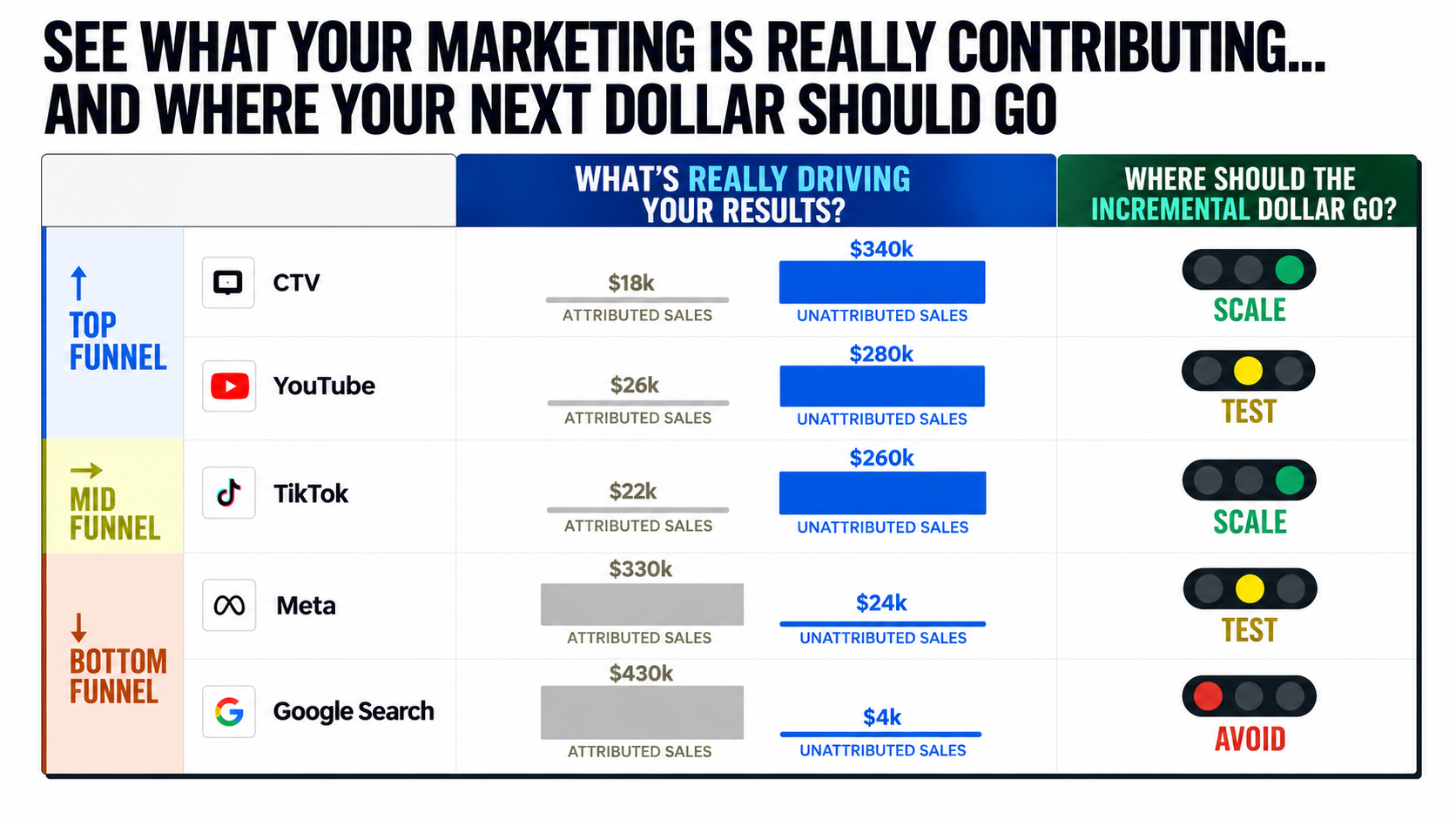
Because the fundamental problem with click-based attribution is that it can only assign credit based on the interactions it observes and the rules it uses.
But a channel can contribute to business performance without receiving the final click.
Blueprint Impact looks beyond attribution credit to evaluate the statistical relationship between advertising investment and downstream business outcomes.
Including revenue that traditional attribution may assign to another channel.
Consider what that means for a retailer increasing its investment in creator-led TikTok advertising.
The videos introduce consumers to new products.
Some consumers search for those products later.
Google Shopping captures the conversion.
And traditional attribution assigns much of the revenue to Google.
With Impact, the retailer can investigate whether changes in TikTok investment are associated with changes in downstream revenue.
Even when TikTok isn't receiving the attribution credit.
That gives the CMO another source of evidence when evaluating whether video investment is contributing to growth.
Not just impressions.
Not just clicks.
Not simply the revenue an ad platform claims.
A clearer view of the relationship between what you're investing and what the business is generating.
That doesn't mean a statistical relationship automatically proves causation.
Controlled experiments remain valuable for validating incrementality.
But Impact can provide additional evidence between those larger studies, helping marketing teams investigate opportunities without waiting for the next six-month measurement cycle.
And that's particularly important when your advertising mix is evolving faster than your traditional measurement process.
Get Updates Like This Monthly
Join our Mailing List
Blueprint Advertising Machine needs the contact information you provide to us to contact you about our products and services. You may unsubscribe from these communications at any time. For information on how to unsubscribe, as well as our privacy practices and commitment to protecting your privacy, please review our Privacy Policy.
Your Next Growth Opportunity Could Be Hiding In The Channels Your Attribution Undervalues
Think about what happens when you combine two facts.
First, consumers are increasingly encountering retail brands through video, creators, and storytelling.
Second, the measurement used to make day-to-day budget decisions can disproportionately reward click-driven advertising.
Now imagine making every major allocation decision using that incomplete picture.
You may continue increasing investment in Google Shopping because it shows the strongest attributable revenue.
Meanwhile, the channels introducing new consumers to your products remain underfunded because their contribution is harder to quantify.
Over time, you risk optimizing your advertising around the demand you've already created rather than investing sufficiently in creating more.
And for a retailer that hasn't saturated its market, that's a costly possibility.
Because the question isn't simply whether Google Shopping works.
Of course it can work.
The question is whether putting another million dollars into Google Shopping will generate more incremental growth than investing some of that money in the channels creating future customers.
That's the decision your measurement needs to help you make.
Blueprint Impact gives retail marketing leaders a way to examine the revenue relationships that attribution alone may miss.
So they can identify where additional investigation or investment may be warranted, rather than assuming the channels with the most attribution credit deserve the most budget.
And when the CMO walks into the next budget meeting, the conversation becomes more useful.
Instead of arguing that video deserves more money because consumers are spending more time watching it...
They can bring evidence about how video investment relates to actual business outcomes.
That's how you start turning upper-funnel allocation from educated guesswork into a more defensible investment decision.
The Retailers That Win The Next Wave Of Growth Won't Just Follow Consumer Attention...
They'll need to understand what that attention is worth.
Because video and creator-led content aren't automatically profitable.
And every dollar invested in awareness isn't necessarily incremental.
But neither is every conversion credited to Google evidence that Google created the demand.
That's the distinction retail CMOs need their measurement to recognize.
The executive we spoke with already understood where his company's advertising was heading.
He was preparing for a future where creator-led content represented a much larger share of the media mix.
He knew the market wasn't saturated.
And he wanted to invest more aggressively in acquiring future customers.
But he also knew that his existing measurement wasn't giving him the confidence to make those decisions as precisely as he wanted.
That's the challenge facing retail marketing leaders as advertising continues to evolve.
You can't confidently scale what you can't adequately evaluate.
And you can't build your next stage of growth by giving all the credit to the channels that capture today's demand.
The opportunity is to follow where your customers are going... With measurement that helps you understand whether the investment is paying off.
FAQ
Why does traditional attribution undervalue video advertising for retailers?
Video advertising often influences consumers before they are ready to purchase. A shopper may discover a product through TikTok, Instagram, YouTube, or creator-led content and later convert through Google Search or Shopping. Click-based attribution can assign most of the credit to the final conversion channel, leaving the earlier video exposure underrepresented.
How can retail CMOs measure the impact of creator-led and UGC advertising?
Retail CMOs can combine traditional attribution with incrementality experiments, geo-lift studies, and statistical impact analysis. Blueprint Impact evaluates relationships between advertising investment and downstream revenue, helping identify potential contributions from channels that do not consistently generate attributable clicks.
Why can Google Shopping receive too much credit for retail sales?
Google Shopping frequently captures consumers with strong purchase intent. Some of those consumers may have discovered a product earlier through social video, creators, or other advertising. When attribution emphasizes the final click, Google Shopping can receive credit for sales influenced by earlier marketing activity.
How can retailers decide whether to increase upper-funnel advertising investment?
Retailers should evaluate whether upper-funnel investment is associated with incremental business outcomes, not just impressions or clicks. Controlled experiments can help establish causal impact, while statistical impact analysis can provide additional evidence about the relationship between channel spending and revenue between testing cycles.
What is the difference between attribution and Impact measurement?
Attribution assigns conversion credit to identifiable marketing interactions. Blueprint Impact examines statistical relationships between advertising investment and downstream business outcomes, including revenue that may not be credited to the originating channel. The approaches provide complementary perspectives and should not be treated as interchangeable measures of causality.
Can video advertising contribute to retail sales without generating clicks?
Yes. Consumers can discover products through video, remember them, and purchase later through another channel. The difficulty is determining how much of that purchasing activity is attributable or incremental to the original video investment. Statistical impact analysis and controlled experiments can help investigate that contribution.