


“We really have no earthly clue how our top-of-funnel channels are helping us... or if they are at all.”
That's what a senior marketing leader told us during a recent conversation.
And she wasn't talking about some small experimental advertising budget.
Her team was actively investing in paid social, with LinkedIn accounting for the largest share, alongside newer investments in other channels.
They could see the engagement.
They could see the clicks.
They could even see pipeline moving three to six months later.
But connecting those results back to the advertising that might have created them?
That was another story.
“We don't know their impact.”
Her team was using last-touch attribution, which meant organic traffic and paid search were getting most of the visible credit.
Meanwhile, the channels they were investing in to create demand were left in a gray area.
And when I say gray area, I mean they couldn't confidently tell whether those investments were contributing to pipeline at all.
Think about what that does to your marketing strategy.
You're spending money on LinkedIn to get in front of future buyers.
You're trying to build demand among people who may not be ready to speak with Sales for months.
And when leadership wants to know what that investment is producing...
You can show them how many people clicked.
How many engaged.
Maybe even how pipeline has changed over the last quarter.
But you can't put a credible number behind the business impact of those campaigns.
Which leaves you with an uncomfortable decision.
Do you keep investing in a channel you can't prove is working... or pull money out of something that might be creating your next wave of customers?
That's the problem traditional attribution keeps leaving B2B marketing teams to solve on their own.
And it's exactly why we built Blueprint's Impact Score.
Your Pipeline Is Growing... But What's Actually Creating It?
The marketing leader described how her team evaluates paid social today.
They look at the individual ads.
They check engagement.
They watch clicks.
Then, months later, they look at pipeline.
If pipeline has increased, maybe their campaigns helped.
If it hasn't, maybe the campaigns aren't working.
But that's about as far as the analysis goes.
Her description was painfully familiar:
“We're flying blind. We don't know what's working.”
And the problem isn't that her team lacks sophisticated marketing technology.
It's that the numbers available to them don't answer the question they're actually trying to solve.
Consider what happens when a potential buyer first encounters your company through LinkedIn.
Maybe they see a video.
A few weeks later, they come across another campaign.
Eventually, they search for your company, visit the website and convert.
Your attribution system may give most or all of the credit to that final search.
Which makes perfect sense if you're measuring where the conversion happened.
But it tells you very little about what helped create the demand that made the conversion possible.
And in B2B, where the buying process can stretch across months, that's an enormous blind spot.
Because the campaigns creating awareness today may not show their value until the pipeline starts materializing next quarter.
By then, you've already made dozens of budget decisions.
Maybe you've cut the campaign that was helping.
Maybe you've doubled down on the channel that was simply capturing demand someone else created.
The channel getting the credit isn't necessarily the channel creating the growth.
And until you can measure that difference, you're making allocation decisions with only part of the picture.
The Missing Number In Your Top-Of-Funnel Reporting
Most marketing teams can tell you exactly how much they spent on LinkedIn last month.
They can tell you how many impressions they bought.
How many clicks they generated.
What their cost per click was.
And they'll have charts showing whether those numbers improved or declined.
But ask them how much pipeline that investment actually helped create...
And suddenly the conversation gets a lot less precise.
That's because traditional attribution generally relies on observable customer interactions.
It tries to connect an individual conversion to the marketing touchpoints that preceded it.
And that's useful.
We use attribution in Blueprint too.
But there's a significant part of marketing that can't be fully understood through those individual customer journeys.
Think about someone who watches your video but doesn't click.
Or encounters your brand repeatedly before eventually coming back through search.
Or sees your advertising in an environment where there's no direct click path to follow.
Those exposures may contribute to demand.
But a click-based attribution system can miss much of their effect.
So the real question becomes...
How do you measure the business impact of advertising when you can't trace every customer directly back to the ad?
That's where Impact comes in.
Impact: An Always-On Revenue Scoreboard For Top Of Funnel
Instead of asking which ad a customer clicked before converting, Impact asks a different question.
When spending changes in a channel, what happens to downstream business results?
Blueprint brings together advertising spend across your media mix and examines how changes in that spend relate to changes in the business outcomes you're measuring.
For an ecommerce company, that might mean purchases.
For a B2B SaaS company, it can mean qualified pipeline or closed-won revenue, provided those events are connected and the data supports the analysis.
As more information comes in, the system evaluates those relationships and develops statistical confidence in the signals it identifies.
This creates another way to evaluate channels whose contributions may not appear clearly in traditional attribution.
So instead of relying entirely on whether LinkedIn received credit for a conversion, you can also examine whether changes in LinkedIn investment are associated with changes in downstream business results.
The same principle can apply to YouTube, CTV, programmatic and other channels where a direct customer path may be incomplete.
This isn't another report you commission, wait weeks to receive, and then hope is still relevant when your next budget meeting arrives.
Impact is designed to evaluate those relationships continuously as new spend and outcome data become available.
That means your understanding can develop as your advertising changes.
And instead of treating top-of-funnel measurement as a special project you revisit every few months, you can make it part of how you manage your media investment.
But the real value becomes obvious when you picture what this does to your next conversation with leadership.
Imagine Walking Into Your Next Budget Meeting With The Numbers Already Buttoned Up...
Leadership wants to know whether your top-of-funnel budget is paying off.
Normally, this is where you'd pull together your LinkedIn engagement numbers, pipeline reports, a few attribution dashboards and whatever analysis your team has managed to complete.
Then spend half the meeting explaining why the numbers don't quite connect.
Now imagine opening one scoreboard instead...
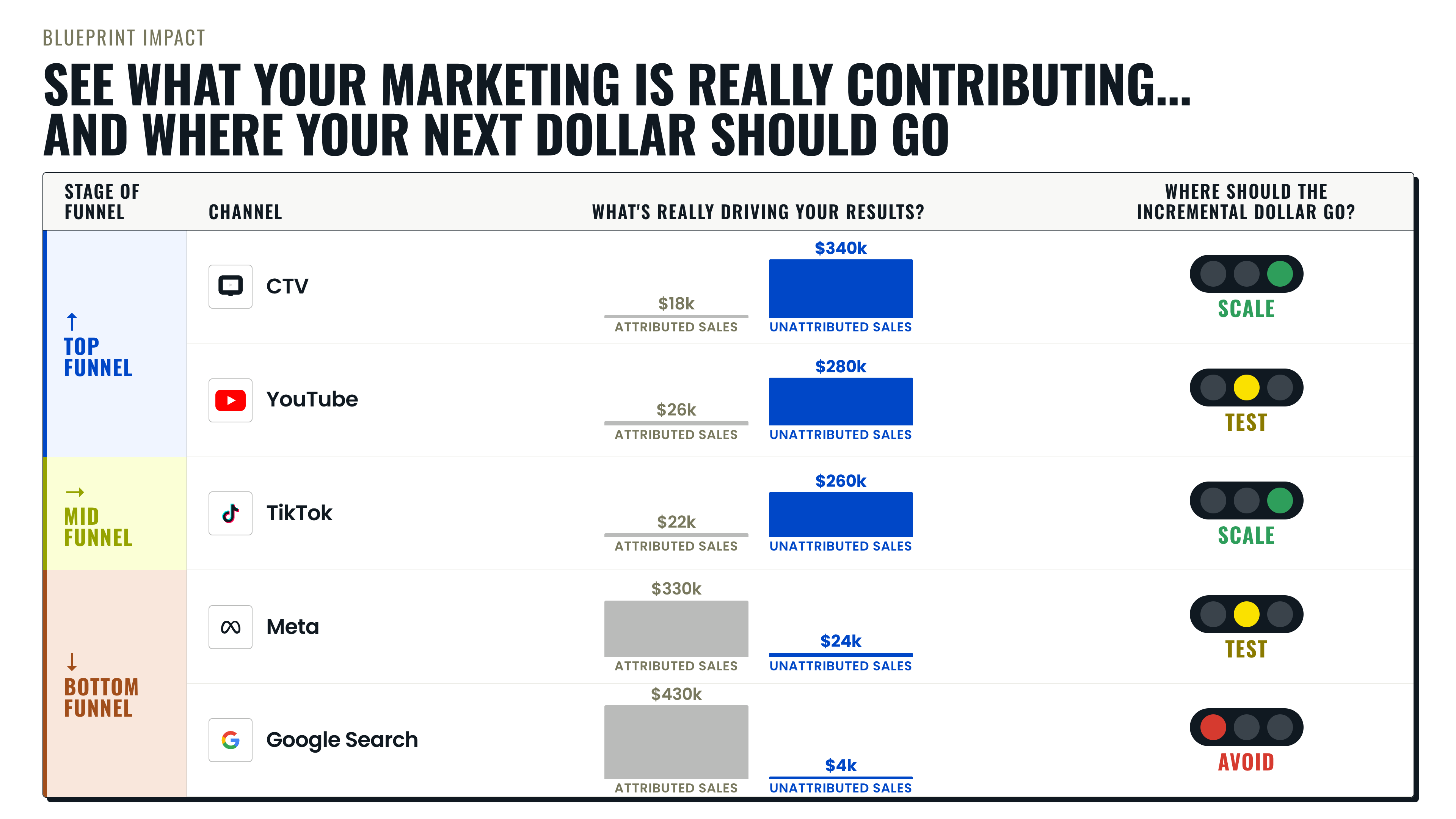
Your major advertising channels are laid out in front of you.
You can see the results traditional attribution connects to each channel.
And alongside that, you have Impact measurements showing how changes in channel investment relate to downstream business performance.
Suddenly, you have a way to examine the contribution of channels that weren't receiving much attribution credit.
Maybe LinkedIn has relatively little directly attributed pipeline.
But its Impact Score reveals a meaningful relationship between increased investment and downstream results.
Or maybe another channel you've been defending isn't showing the relationship you expected.
Either way, you have more than a collection of engagement metrics and a theory about what might be happening.
You have evidence you can use to make the next decision.
And that's where the conversation changes.
Because leadership doesn't just want to know what happened.
They want to know what you plan to do about it.
Imagine being asked where the next incremental $250,000 should go.
With Impact, you can examine which channels are showing meaningful relationships with business outcomes.
Then look at where additional investment may still have room to produce results.
Because a channel that's working today isn't automatically the best place to put another dollar.
At some point, additional spend starts producing smaller gains.
Blueprint helps identify where those returns begin to bend, so you can evaluate whether a channel still has room to scale or whether another investment may offer a better opportunity.
Now you're walking leadership through an actual allocation strategy.
Here's what our attribution shows.
Here's what Impact is revealing about the channels traditional attribution struggles to measure.
Here's where we're seeing evidence of productive investment.
And here's where the next incremental dollar appears to have the strongest opportunity.
That's an entirely different conversation from explaining why LinkedIn got 40,000 impressions last month.
And because Impact is designed to update continuously, you're not starting from scratch every time someone asks the question.
You're opening your scoreboard.
Get Updates Like This Monthly
Join our Mailing List
Blueprint Advertising Machine needs the contact information you provide to us to contact you about our products and services. You may unsubscribe from these communications at any time. For information on how to unsubscribe, as well as our privacy practices and commitment to protecting your privacy, please review our Privacy Policy.
One Marketing Leader Believed CTV Was Working For 18 Months... But Couldn't Prove It
One media leader believed CTV was an important part of his company's advertising mix.
He had been making the case for it for roughly 18 months.
But his data team wasn't convinced.
The measurable results kept pointing toward Meta, so the pressure was to continue allocating more money there.
CTV represented only about 10% of the budget.
And without compelling evidence of its downstream contribution, it was difficult to justify increasing that investment.
When Blueprint evaluated the media mix using Impact, CTV showed a surprisingly strong relationship with downstream results.
The Impact Score was approximately 60% in the account shared with us.
That didn't mean CTV had directly generated 60% of all sales.
It meant the channel was showing a substantial measured relationship with the business outcomes being analyzed.
And that gave the team a reason to investigate a different allocation strategy.
They began increasing CTV investment incrementally.
As they did, the business results moved with it.
The team also reduced investment in channels that weren't showing meaningful impact.
Now, the important part of this story isn't that Blueprint convinced someone to try CTV.
The marketer already believed CTV was working.
What changed was his ability to support that belief with evidence strong enough to act on.
After months of disagreement about where the money belonged, he finally had a way to make the allocation decision using more than directly attributed conversions.
And that's precisely the opportunity for B2B marketing leaders trying to understand whether their awareness campaigns are contributing to pipeline.
Your Next Budget Decision Shouldn't Depend On A Guess
“We really have no earthly clue...”
She wasn't saying her team wasn't working hard enough.
She wasn't saying they didn't know how to run paid social campaigns.
And she certainly wasn't saying LinkedIn was a waste of money.
She was saying they didn't have the measurement needed to determine whether their investment was producing the business results they were responsible for.
That's a very different problem.
Because improving click-through rates won't necessarily solve it.
Neither will adding another dashboard that reports the same attributed conversions.
What she needs is a way to understand how top-of-funnel investment relates to pipeline, even when the individual customer journey doesn't tell the whole story.
And then use that understanding to decide where the next dollar should go.
That's the reason we built Impact.
To give marketers another way to put numbers behind the channels that are hardest to measure.
To help them see where their advertising investment is associated with meaningful business results.
And to make it easier to identify where additional spend may still have room to grow.
Because you shouldn't have to wait six months, watch pipeline move, and hope your top-of-funnel campaigns had something to do with it.
You should be able to walk into your next budget meeting with a clearer picture of what's contributing to growth...
And a much stronger case for where to invest next.
FAQ
How can B2B marketers measure the impact of top-of-funnel advertising?
B2B marketers can evaluate top-of-funnel impact by examining how changes in advertising spend relate to downstream business outcomes such as qualified pipeline and closed-won revenue. Blueprint's Impact provides a statistical measurement layer alongside traditional attribution, helping marketers evaluate channels whose contributions may not be fully visible through individual customer journeys.
What's the difference between attribution and Blueprint's Impact?
Attribution connects conversions to observable marketing touchpoints in a customer's journey. Impact examines statistical relationships between advertising investment and downstream business results. Together, they offer complementary views of marketing performance, including channels that may influence demand without receiving direct attribution credit.
Can Impact help prove whether LinkedIn advertising creates pipeline?
Impact can help evaluate whether changes in LinkedIn investment are associated with changes in pipeline, when the necessary spend and business-outcome data are available. It does not automatically establish that every observed pipeline change was caused by LinkedIn, but it provides additional evidence beyond clicks, engagement and last-touch attribution.
How does Impact help determine where to increase advertising spend?
Impact helps marketers assess which channels show meaningful relationships with downstream results and where additional investment may still be productive. By examining changes in performance as spending increases, marketers can identify potential scaling opportunities and signs of diminishing returns.
Is Impact a replacement for marketing mix modeling?
Impact Score provides continuously updated analysis of relationships between advertising spend and business outcomes. Rather than positioning it as a replacement for a particular methodology, Blueprint uses Impact alongside attribution and other measurement capabilities to support ongoing media investment decisions.