


Six agencies. $6 million a year in fees... And nobody could tell them what was actually driving growth.
They had the dashboards.
They had the reports.
They had specialists managing every advertising channel.
What they didn't have was the one thing that mattered most...
The confidence to know where their next advertising dollar would generate the greatest return.
So this $100 million telehealth company made a decision that would make most CMOs nervous.
They fired six agencies.
Brought advertising in-house with just nine people.
And over the following 12 months, nearly doubled revenue.
But the most interesting part wasn't the money they saved on agency fees...
It was what they discovered that gave them the confidence to spend dramatically more.
Six Agencies... And Six Different Versions Of What Was Working
Hiring the best agency for every channel sounds like a foolproof growth strategy.
You get specialists who know their platforms inside and out.
Meta experts optimizing Meta.
Google experts optimizing Google.
Creative teams testing new messages.
And everyone reporting on the results they're generating.
What could go wrong?
Well, plenty.
Because each agency is looking at performance through its own platform, reporting, and attribution.
And while each team may be optimizing its individual campaigns...
Nobody necessarily knows whether the entire advertising portfolio is being optimized for the greatest return.
That's a very different problem.
One platform may be capturing demand created somewhere else.
A campaign that looks inefficient in isolation may be contributing to revenue that gets credited to another channel.
And a campaign reporting excellent returns may already be approaching diminishing marginal returns.
Meanwhile, the CMO is left trying to reconcile the numbers and decide where the next million dollars should go.
For this telehealth company, the complexity was enormous.
It was managing advertising across multiple platforms, audiences, creative variations, and content themes.
And the bigger the business grew, the harder it became to make those trade-offs confidently.
More agencies weren't necessarily the answer.
More dashboards certainly weren't.
They needed a way to understand what was actually driving the business... Not just what each platform claimed was working.
And as we've seen with other sophisticated advertisers, conflicting dashboards can start destroying your credibility with leadership long before anyone realizes how much money is being allocated based on incomplete information.
The Problem Wasn't A Lack Of Data... It Was What The Data Couldn't Tell Them.
Most large advertisers already have more data than they know what to do with.
Clicks.
Conversions.
Campaign performance.
Audience metrics.
Creative results.
And enough dashboards to keep an entire analytics department occupied.
But there's a fundamental limitation to relying exclusively on attribution.
It tells you which channels receive credit for conversions according to the interactions your systems can observe.
It doesn't necessarily tell you which advertising investments are creating additional demand or contributing to revenue elsewhere in the funnel.
And that's particularly important for brands investing heavily in awareness, video, and creator-led advertising.
Someone may watch a video, become interested in a product, and search for it days later.
Another consumer may see advertising repeatedly before visiting the website directly.
A third may discover the brand through an upper-funnel campaign, leave, and eventually convert through a different channel.
The final conversion is recorded.
But the advertising that helped create the demand may receive little credit.
It's how Google keeps stealing credit for customers your upper funnel created.
And if you're making allocation decisions using only those attributable conversions...
You may be starving the very channels responsible for bringing your next customers into the funnel.
This was one of the critical opportunities the telehealth company needed to understand.
Not simply which ads were getting conversions.
But where additional investment could contribute to growth, including channels whose impact wasn't fully represented in traditional attribution.
The Breakthrough Was Seeing The Entire Advertising Business As One System
Instead of trying to reconcile six agencies and their competing reports, the company brought its advertising operation in-house.
Nine people.
Managing a business that would eventually scale annual advertising investment to $150 million.
And the key wasn't that nine people suddenly became better at manually analyzing advertising than six specialized agencies.
It was that they changed how advertising decisions were made.
Using Blueprint, the team could bring cross-platform advertising performance into a unified picture.
Instead of treating Meta, Google, TikTok, and other platforms as separate worlds, they could evaluate campaigns, audiences, creative variations, and spending across the broader portfolio.
That made a different kind of optimization possible.
Not simply asking whether an ad was performing well on Meta.
But whether that money could produce a better result somewhere else.
Not simply identifying which creative had the most conversions.
But understanding how different creative variations performed across platforms and audiences.
And not simply increasing spend on whatever campaign reported the highest return.
But evaluating where there was additional room to scale.
Because when you're managing millions in advertising, the most valuable question isn't always:
What's working?
It's:
Where should the next dollar go?
And when your team is already stretched thin, the last thing you need is another system that makes them spend hours hunting for that answer.
That's why a marketing stack that actually gives your team time back becomes so important when you're trying to scale without adding another layer of operational complexity.
A $25,000-A-Day Budget Decision That No Single Dashboard Could Make
One Meta audience was receiving substantial investment.
But when Blueprint evaluated performance across platforms, it identified an opportunity to reduce that allocation.
The recommendation?
Decrease the Meta budget by approximately $25,000 per day and move that money toward TikTok.
That's roughly $750,000 in potential monthly reallocation at a 30-day run rate.
Not a minor campaign adjustment.
A decision involving serious money.
And it wasn't based simply on what Meta reported about Meta.
The recommendation came from evaluating cross-platform performance and the relationships between audiences, creative, and spending.
Money that might be working harder somewhere else.
Creative that might deserve greater distribution on another platform.
Audiences where additional spending might be less productive than reallocating the same budget.
And that's when a conversation about advertising efficiency starts becoming a conversation about growth.
Because the goal isn't merely to cut underperforming campaigns.
It's to find where the business has room to invest more.
But There Was Another Problem... Top-Of-Funnel Advertising Wasn't Getting The Credit It Deserved
Cross-platform optimization was one part of the solution.
The other was understanding what traditional attribution was missing.
Because even when you can compare campaigns across platforms, you still face a problem if the underlying conversion data doesn't adequately recognize the contribution of upper-funnel advertising.
Think about video and UGC.
These formats can introduce consumers to a brand, create interest, and influence future purchasing decisions.
But they don't always generate immediate clicks.
A consumer may see an ad on TikTok and later search on Google.
Google receives the conversion credit.
TikTok looks less efficient.
And the next budget decision gets made using an incomplete picture.
This is becoming particularly important as retail advertising moves toward video while attribution continues rewarding clicks.
That's where Blueprint Impact added another layer of evidence.
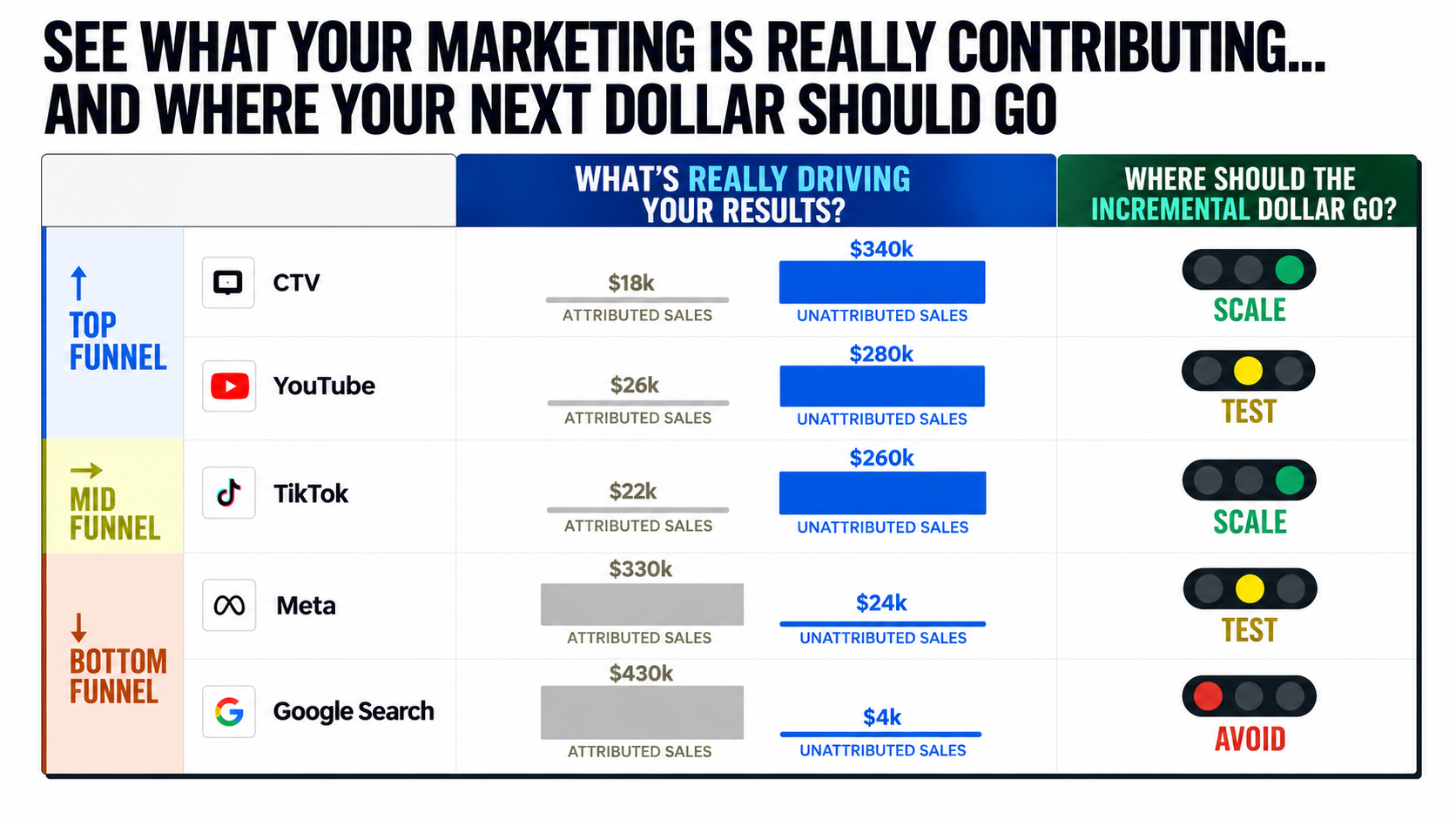
Impact evaluates statistical relationships between advertising investment and downstream business outcomes.
Including revenue that traditional attribution may credit to another channel.
So instead of evaluating top-of-funnel advertising exclusively through its attributable conversions, the team could examine whether changes in investment were associated with changes in overall business performance.
That matters when deciding whether to increase spending on channels that create demand.
Because a channel can contribute to growth without receiving the final click.
And if you're trying to make the case for investing more aggressively in video, UGC, or other upper-funnel media, you need evidence that goes beyond what the platform claims.
Impact helps provide that additional perspective.
It doesn't mean every correlation proves causation.
Or that controlled incrementality testing becomes unnecessary.
But it gives marketing leaders a way to investigate revenue relationships that attribution alone may not reveal.
And that can change the conversation from whether upper-funnel advertising deserves a budget... to where additional investment has the strongest supporting evidence.
The Difference Between Knowing What's Working And Knowing Where You Can Scale
The telehealth company didn't simply improve its reporting and call it a day.
Its annual advertising investment grew from approximately $35 million to $150 million.
That's more than four times the original spend.
And the company did it while operating with a nine-person internal team.
Consider what that represents.
At $35 million a year, even small allocation mistakes are expensive.
At $150 million, those same inefficiencies become much more consequential.
You can't afford to keep increasing budgets simply because an individual platform reports strong returns.
You need to understand where there's still headroom.
Where spending is approaching diminishing returns.
And which channels may be contributing more to business growth than their attribution suggests.
Because attribution can be good enough to keep spending but not good enough to scale.
That's why the combination of unified measurement, cross-platform optimization, and Impact mattered.
One helped the team see performance across the advertising portfolio.
Another helped identify opportunities to shift spending between platforms, audiences, and creatives.
And Impact helped evaluate revenue relationships beyond traditional attribution, including potential contributions from top-of-funnel media.
Together, those capabilities supported a more informed approach to deciding where additional investment might be justified.
Instead of relying on six disconnected sets of recommendations.
Or making allocation decisions solely on the basis of whichever platform claimed the most conversions.
From $35 Million To $150 Million In Annual Ad Spend... Without Rebuilding The Agency Machine
The business results were substantial.
The company nearly doubled revenue over a 12-month period.
$600 million in additional enterprise value over 18 months.
Those outcomes can't be attributed to one feature or one budget decision alone.
Instead of paying six agencies to manage separate pieces of the advertising operation, the company built a centralized team with a clearer view of the whole business.
Instead of relying exclusively on platform-level results, it could evaluate performance across channels.
And instead of allowing traditional attribution to dictate every upper-funnel investment decision, it had another way to investigate how advertising spending related to downstream revenue.
That's a very different operating model.
One designed not simply to manage a large advertising budget.
But to identify opportunities to make that budget more productive as the business grows.
Get Updates Like This Monthly
Join our Mailing List
Blueprint Advertising Machine needs the contact information you provide to us to contact you about our products and services. You may unsubscribe from these communications at any time. For information on how to unsubscribe, as well as our privacy practices and commitment to protecting your privacy, please review our Privacy Policy.
The Real Lesson Isn't To Fire Your Agencies
It's tempting to look at this story and conclude that every large advertiser should fire its agencies and bring everything in-house.
But that misses the point.
A talented agency can be extremely valuable.
And bringing advertising in-house doesn't automatically solve a measurement problem.
You can have nine employees looking at disconnected dashboards just as easily as six agencies.
The real breakthrough was changing the information available to the people making the decisions.
Because whether your advertising is managed internally, externally, or through some combination of the two, the questions remain the same.
Which investments are contributing to growth?
Where is money being wasted?
Which campaigns are approaching diminishing returns?
And where can you confidently increase spending without simply paying more to capture the same demand?
Those are portfolio-level decisions.
And they require a broader view than any single platform can provide.
For the telehealth company, that shift helped support a radically different approach to managing and scaling advertising.
The nine-person team became the visible part of the transformation.
But the more important change was what that team could finally see.
Your Next Revenue Breakthrough Might Not Require More Agencies... Or More Budget
It may require a better understanding of the budget you're already managing.
Because somewhere inside a large advertising portfolio, there may be campaigns receiving more money than they deserve.
Other campaigns that could perform better with additional investment.
And upper-funnel channels whose contribution to revenue is being underestimated because the conversions happen somewhere else.
The challenge is finding those opportunities before the money gets allocated based on incomplete information.
That's what made this company's transformation so significant.
It didn't simply reduce agency overhead.
It changed how the team evaluated performance, identified headroom, and made investment decisions.
And that helped support a business that nearly doubled revenue while scaling its advertising operation dramatically.
Six agencies couldn't give them the complete picture they needed.
But once they could see the business differently, they could start making very different decisions.
FAQ
How did a $100 million telehealth company nearly double revenue with nine advertising employees?
The company brought advertising operations in-house after previously working with six agencies. It adopted unified cross-platform measurement and optimization capabilities that helped its internal team evaluate campaigns, audiences, creative, and budget allocations across channels. Blueprint Impact also provided another way to examine revenue relationships that traditional attribution could miss. Revenue nearly doubled over 12 months.
How can large advertisers identify where they have room to increase spending?
Large advertisers can evaluate performance across platforms, audiences, and creative variations while examining where additional investment may produce better outcomes. Cross-platform optimization can help identify reallocation opportunities, while statistical impact analysis can provide additional evidence about channels that may contribute to revenue without receiving traditional attribution credit.
What is Blueprint Impact?
Blueprint Impact evaluates statistical relationships between advertising investment and downstream business outcomes. It helps marketers investigate the potential contribution of channels that traditional attribution may undervalue, particularly upper-funnel media that influences purchasing behavior without generating the final conversion click.
Why can traditional attribution undervalue top-of-funnel advertising?
Traditional attribution depends on observable marketing interactions and the rules used to assign conversion credit. A consumer may discover a brand through video or UGC and later purchase through Google Search, direct traffic, or another channel. As a result, the original advertising exposure may receive little credit even when it contributed to demand.
Can a smaller internal team manage a large advertising budget?
A smaller team may be able to manage substantial advertising investment when it has the systems, expertise, and processes needed to evaluate performance and make decisions efficiently.
How can CMOs justify increasing investment in video and UGC?
CMOs can combine attribution data with statistical impact analysis and controlled incrementality testing to build a more complete evidence base. This can help them investigate whether upper-funnel investment is associated with downstream revenue growth, assess potential headroom, and make more informed budget requests.