


“Sales takes all the credit... we don't even get an assist on it.”
That's how one B2B marketing leader described what happens when his company's enterprise deals finally close.
Marketing may have been influencing those buyers for six months before Sales ever spoke to them.
His company sells complex financial products to enterprise and midmarket customers, where sales cycles can stretch six months or longer.
During that time, prospective customers may encounter the company's advertising repeatedly before they're ready to talk to Sales.
“Someone may see an ad and then six months from now... we are in their consideration set because... we've had steady ads targeting them.”
But when those buyers finally enter the sales process, the connection to marketing gets lost.
Sales closes the deal.
Revenue gets recorded.
And the advertising that may have helped make the company a serious contender receives little or no recognition.
Not because marketing necessarily failed to contribute.
Because the company's measurement can't reliably show what happened before Sales entered the picture.
Your Marketing Could Be Helping Create Millions In Revenue... Without Getting Credit For It
Think about the last major enterprise deal your company closed.
Sales probably knows when the first meeting happened, who the decision-makers were, how the opportunity progressed, and how much revenue the contract represents.
But what happened before that first meeting?
Was the buyer exposed to your advertising three months earlier?
Did a YouTube campaign introduce them to your company?
Did LinkedIn advertising keep your brand in front of the buying committee?
Did a series of top-of-funnel campaigns help put you on the shortlist before anyone filled out a form?
Maybe.
But if your reporting starts with the first identifiable lead or the last conversion, much of that earlier activity may never appear in the revenue story.
Which creates a problem far bigger than an incomplete dashboard.
Leadership may be evaluating marketing's contribution to the business without seeing a substantial part of what marketing actually does.
And the longer your sales cycle, the larger that blind spot can become.
The Six-Month Gap That Makes Marketing Look Less Valuable Than It Is
For this marketing leader, the problem wasn't a lack of software.
“We've got Salesforce, we've got 6 Sense, we've got Marketo. They all don't talk to each other.”
That left the team struggling to connect advertising activity to downstream sales.
And when he described how the organization measured performance, one detail stood out.
“We tend to be just last touch attribution.”
There it is.
A customer might spend six months encountering advertising, researching the company and gradually moving toward a buying decision.
But if the measurement system emphasizes the final interaction, most of that journey gets ignored.
The last touch gets the credit.
Sales gets recognized for closing the deal.
And the channels that may have helped create the opportunity are left fighting to justify their budgets.
This is especially painful for top-of-funnel advertising.
Because the very campaigns designed to create future demand are often the hardest to connect directly to a closed sale.
Which means the CMO faces an uncomfortable question when leadership reviews the budget.
If you can't show how your top-of-funnel investment contributes to closed sales, why should the company keep funding it?
That's the problem with judging marketing on revenue when it can only prove clicks.
The business wants evidence of revenue contribution.
But the measurement system keeps reporting activity.
What If You Could Show Leadership The Revenue Attribution Is Missing?
This is where Blueprint's Impact reporting changes the conversation.
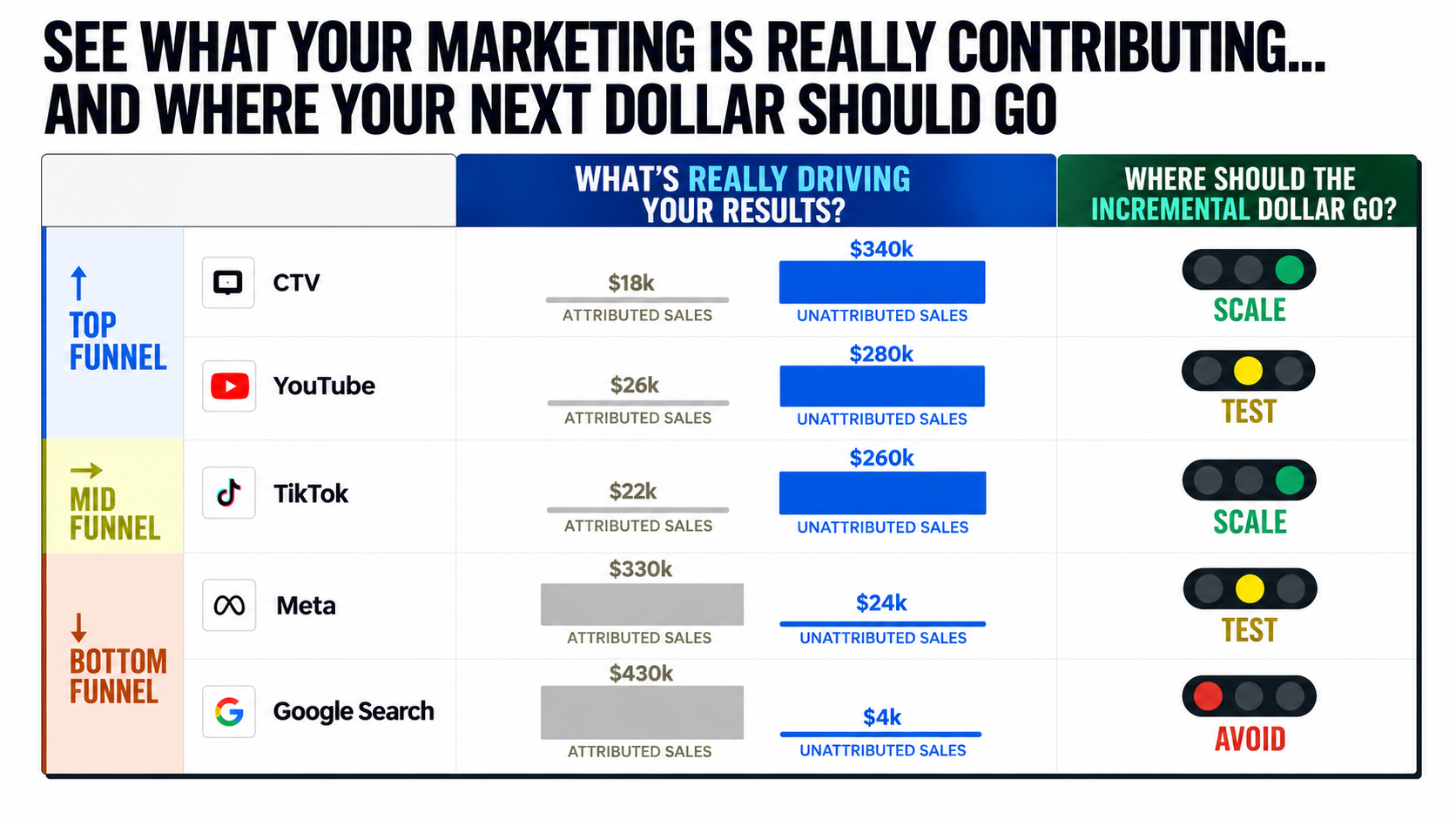
Traditional attribution attempts to assign credit to identifiable marketing touchpoints.
But what happens when a top-of-funnel campaign contributes to demand without receiving an attributable conversion?
That's where the blind spot begins.
Blueprint Impact looks beyond attribution credit to evaluate the statistical relationship between advertising investment and downstream business results.
That means a CMO can investigate whether spending on channels such as YouTube, CTV or programmatic advertising is associated with changes in pipeline and closed-sales revenue... Even when traditional attribution assigns those channels little or no credit.
Consider a hypothetical example.
Your attribution report shows almost no closed-sales revenue credited to a top-of-funnel campaign.
Leadership sees the spend and questions its value.
But Blueprint Impact identifies a meaningful relationship between changes in that channel's investment and subsequent downstream revenue.
Suddenly, you have something more useful to bring into the conversation.
Not a claim that every sale came from that campaign.
Not another engagement metric dressed up as ROI.
Evidence that a channel your attribution barely recognizes may be contributing to the business outcomes leadership actually cares about.
And that's an entirely different conversation from trying to defend awareness spending with impressions and website traffic.
It's also why channels that create demand can lose credit to channels that capture it.
Impact helps uncover the relationship that last-touch attribution may be missing.
But there's another question leadership and Sales will still want answered.
What does the buying journey look like across the customers who actually close?
Show Sales What Your Best Customers Were Doing Before They Entered The Pipeline
This is where Blueprint's Influence reporting becomes especially valuable.
Because looking at one customer's journey can only tell you so much.
Maybe that customer saw a LinkedIn ad before contacting Sales.
Interesting.
But was that an isolated interaction?
Or does LinkedIn consistently appear in the buying journeys of your most valuable customers?
That's the much more useful question.
Blueprint Influence lets you look at customer buying journeys in aggregate, revealing patterns across the customers who ultimately become closed sales.
Instead of examining one deal in isolation, you can study the marketing touchpoints associated with an entire group of customers.
For example, imagine looking at the buying journeys of your highest-value closed-won customers.
You might discover that a substantial percentage encountered top-of-funnel advertising before entering the sales process.
That certain channels consistently appear early in their journeys.
Or that customers who eventually become your largest accounts tend to encounter a different combination of marketing channels than smaller customers.
You're not asking Sales to believe that one advertising impression created one deal.
You're showing them recurring patterns in the marketing interactions of the customers they are successfully closing.
And that creates a far more credible discussion about marketing's contribution.
Because Sales can see the broader marketing activity associated with the customers entering its pipeline.
Marketing can identify which channels consistently appear in the journeys of its best customers.
And leadership gets a more complete picture of the marketing investments associated with the business's most valuable outcomes.
That's a much stronger foundation for understanding how the company acquires customers than looking at the last touch before a lead appeared.
Start With Your Best Customers... Then Work Backward
Most marketing reports start with the advertising.
How much did we spend?
How many people clicked?
How many leads did we generate?
And how much revenue did attribution assign to the campaign?
But what if you reversed the process?
Start with your best customers.
The enterprise accounts that closed.
The highest-value contracts.
The customers generating the revenue leadership wants more of.
Then examine the marketing interactions observed across their buying journeys.
Which channels consistently show up among the customers you most want to acquire?
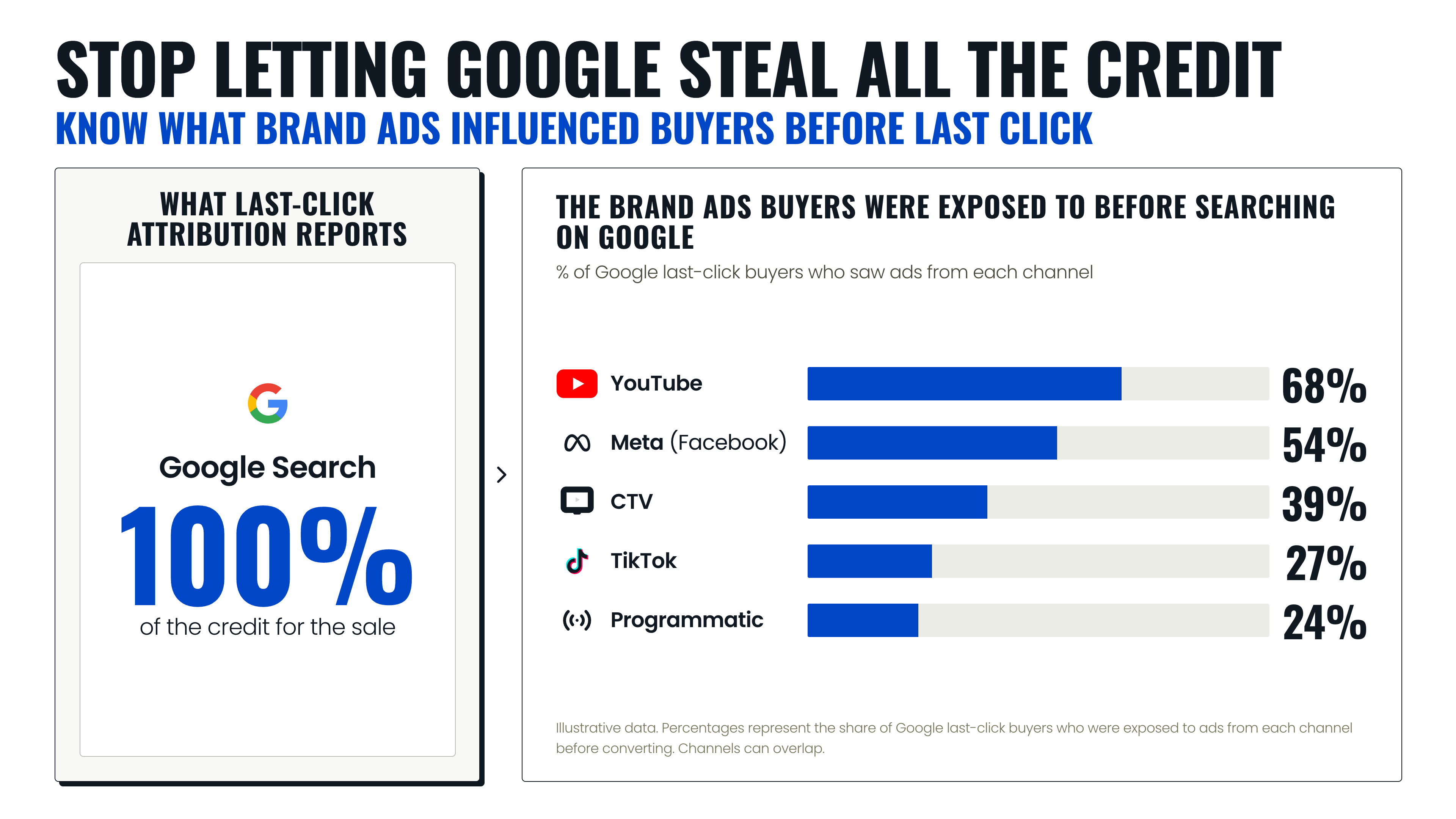
That's where Influence becomes particularly useful.
You can examine patterns across groups of closed-won customers rather than relying on a handful of individual anecdotes.
You can compare the observable marketing journeys of different customer segments.
And you can begin to understand which channels are most frequently associated with the customers producing your best business outcomes.
That doesn't mean the most frequently observed channel necessarily caused those sales.
But it gives Marketing and Sales a much clearer understanding of the customer acquisition journey.
And it creates a more informed starting point for deciding which marketing investments deserve closer attention.
Impact Shows What Attribution Misses... Influence Shows The Patterns Behind Your Best Customers.
This is where the two capabilities become especially powerful together.
Imagine your CMO is defending a significant investment in top-of-funnel advertising.
Traditional attribution gives the channel very little credit.
Sales is closing deals.
But leadership can't see how the advertising fits into the picture.
With Blueprint Impact, the CMO can investigate whether investment in that channel has a meaningful statistical relationship with downstream pipeline and closed-sales revenue.
Then, with Blueprint Influence, the CMO can examine whether that channel appears consistently across the observable buying journeys of customers who ultimately close.
Now the discussion is supported by two different kinds of evidence.
Impact helps reveal revenue relationships that traditional attribution may miss.
Influence helps reveal the marketing patterns associated with your best customers.
Neither is a substitute for controlled experimentation when causal proof is required.
But together, they provide a more complete view than last-touch attribution alone.
And for a marketing leader who currently receives virtually no recognition for advertising's potential contribution to enterprise deals, that's a meaningful change.
Instead of arguing that marketing must have helped because the company was running ads...
You can bring evidence about how advertising investment relates to business performance and where marketing interactions appear across the journeys of closed-won customers.
That's how marketing begins to move from defending its existence to demonstrating its role in business growth.
The Real Opportunity Is Changing The Conversation With Leadership
For years, many B2B marketing leaders have been forced to defend top-of-funnel advertising with metrics that don't fully answer the question leadership is asking.
How many impressions did we buy?
How many people visited the website?
How many leads came in?
Those numbers have their place.
But when the CEO or CFO wants to know what marketing is contributing to closed sales, they're not enough.
Now imagine walking into that same conversation with a different story.
You can show which top-of-funnel channels have measurable relationships with downstream sales performance.
You can reveal which marketing touchpoints consistently appear across the buying journeys of your highest-value customers.
And you can connect those findings to the opportunities and revenue the business ultimately cares about.
That doesn't mean every advertising dollar can be tied to a specific closed sale.
It means you have a more complete, evidence-based way to explain marketing's contribution.
And for a CMO trying to protect investment in the channels that create future demand, that's a meaningful advantage.
Because the goal isn't to take credit away from Sales.
It's to stop making marketing invisible in the story of how the business grows.
Get Updates Like This Monthly
Join our Mailing List
Blueprint Advertising Machine needs the contact information you provide to us to contact you about our products and services. You may unsubscribe from these communications at any time. For information on how to unsubscribe, as well as our privacy practices and commitment to protecting your privacy, please review our Privacy Policy.
Sales Deserves Credit For Closing The Deal. Marketing Deserves Visibility Into Its Contribution.
The marketing leader we spoke with wasn't asking to replace his sales team.
He wasn't claiming every enterprise deal was created by advertising.
He simply wanted to understand what happened during the months before prospects entered the sales process.
And he wanted that contribution recognized when the deals finally closed.
That's a reasonable expectation for any CMO responsible for millions in advertising investment.
Because when Sales gets all the credit and Marketing can't demonstrate its contribution, the organization risks making future investment decisions with an incomplete picture.
The solution isn't another dashboard full of impressions.
It's connecting advertising to the business outcomes that matter.
Using Blueprint Impact to uncover relationships between top-of-funnel investment and downstream revenue that traditional attribution misses.
And using Blueprint Influence to reveal the aggregate buying-journey patterns of the customers the business values most.
So the next time Sales celebrates another record quarter...
Marketing doesn't have to sit there wondering whether its advertising helped make it happen.
It can bring a much clearer picture of the role marketing plays in generating closed sales.
And give leadership and Sales a better understanding of what's really helping drive the business.
FAQ
How can B2B marketing prove its contribution to closed sales?
B2B marketing teams can combine advertising data, CRM sales outcomes, aggregate customer journey reporting and statistical impact analysis. This helps them understand both the marketing interactions commonly observed among closed-won customers and the relationship between advertising investment and downstream revenue.
Why does last-touch attribution undervalue B2B marketing?
Last-touch attribution emphasizes the final measurable interaction before conversion. In B2B companies with long buying cycles, advertising may influence buyers months earlier. Those earlier interactions can receive little or no credit even when they were part of the customer's journey.
What is the difference between Blueprint Impact and Blueprint Influence?
Blueprint Impact evaluates statistical relationships between marketing investment and downstream business outcomes, helping reveal potential contributions that traditional attribution misses.
Blueprint Influence analyzes observed marketing interactions across groups of customers, showing which channels and touchpoints appear consistently in the buying journeys of customers who eventually close.
How does aggregate customer journey analysis help B2B marketing teams?
Aggregate analysis reveals patterns that may not be apparent when examining individual customers. Marketers can identify which channels commonly appear in the journeys of their highest-value customers, compare customer segments and develop a clearer understanding of the marketing activity associated with closed sales.
Can top-of-funnel advertising influence closed sales six months later?
Yes, top-of-funnel advertising can be part of a long B2B buying journey. Buyers may encounter brand advertising repeatedly before contacting Sales. However, observing those interactions does not establish that a particular campaign caused a sale. Aggregate Influence reporting and statistical Impact analysis provide complementary evidence.
How can marketing and sales teams improve revenue attribution?
They can connect marketing-platform and CRM data, examine aggregate buying-journey patterns among closed-won customers, and evaluate downstream revenue alongside advertising investment. This creates a more complete shared picture of customer acquisition without requiring either team to claim exclusive credit.