


“Maybe we're doing something right.”
That's how one senior B2B marketing leader described the relationship between her team's advertising investments and the pipeline they were responsible for generating...
Not exactly the kind of confidence you'd expect from a team managing a significant paid media program.
But here's what makes her admission so interesting.
Her team wasn't struggling to generate engagement.
They knew which ads people were clicking.
They knew which campaigns were attracting attention.
And they could see whether pipeline was increasing three to six months later.
The problem was everything happening in between.
“My team will look at in-channel results to understand... is this ad working?”
“Is it driving engagement? Is it driving clicks?”
“But beyond that we don't know.”
Your team is responsible for creating pipeline.
You're investing real money into LinkedIn and other paid social channels.
Your campaigns are running.
Your reports are updating.
And when someone asks which advertising investments are actually helping generate new customers...
The best answer you have is that pipeline seems to be moving in the right direction.
Maybe.
That's an awful lot of money to manage on a maybe.
And it's a problem I keep hearing from marketing leaders who have plenty of data but surprisingly little confidence in what that data is telling them.
The Dangerous Guesswork Behind An Always-On Marketing Program
Her marketing was generally always on.
Which meant she couldn't easily isolate one campaign, watch what happened, and confidently connect the results to that particular investment.
There was no clean starting line.
No obvious stopping point.
No simple experiment she could look back on and say, “That's what created the increase in pipeline.”
Instead, the team was continuously investing across channels while trying to piece together the results afterward.
And that creates a problem that goes well beyond reporting.
Because marketing teams don't just measure performance.
They make decisions based on what they measure.
Every week, someone decides which campaign deserves more money.
Which audience should be expanded.
Which creative needs to be replaced.
Which channel should lose budget.
And which one should get more.
But what happens when the information guiding those decisions stops at clicks and engagement?
You start optimizing for the things you can see.
An ad generates a lot of clicks?
Looks promising.
Another campaign produces leads at a lower cost?
Maybe it deserves more budget.
A third campaign generates fewer leads and costs more?
Time to cut it.
Except there's one rather important question nobody has answered.
Which of those campaigns is actually producing customers?
Because the cheapest lead isn't necessarily the best lead.
And the campaign generating the most engagement isn't necessarily the one creating the most pipeline.
In fact, you could be moving money away from the advertising that's attracting your best customers...
And putting it into campaigns that look terrific in your dashboard but rarely produce a closed deal.
That's the danger of making budget decisions without connecting marketing performance to downstream business results.
You're not necessarily optimizing for growth.
You're optimizing for whatever your measurement system happens to show you.
Your Best Campaign Might Look Like Your Worst Campaign
Imagine two LinkedIn campaigns.
The first generates 200 leads.
The second generates 75.
On the surface, the decision seems obvious.
Campaign A is generating nearly three times as many leads.
If your team is measured on lead volume, that's probably where the next dollar goes.
But now imagine looking at what happened after those leads entered your sales process.
Of the 200 leads from Campaign A, only a handful became qualified opportunities.
And almost none became customers.
Meanwhile, Campaign B's 75 leads turned into a meaningful number of sales opportunities, several of which eventually closed.
Suddenly, the campaign that looked less productive at the top of the funnel starts looking considerably more valuable.
Those numbers are hypothetical, but the problem is very real.
You can't know which campaign deserves more budget if you're measuring the wrong finish line.
And this gets even more complicated when the buying journey involves multiple channels.
Someone discovers your company through LinkedIn.
They encounter another ad a few weeks later.
They visit your website.
Eventually, they search for your company on Google, request a demo and become a customer.
Your last-touch attribution gives Google the credit.
Meanwhile, the LinkedIn campaigns that helped introduce the buyer to your business are left looking like an expensive exercise in generating engagement.
Now imagine your team making next month's budget decisions using those numbers.
Google looks like the winner.
LinkedIn looks questionable.
But you don't actually know what would happen to future pipeline if you started cutting LinkedIn.
And that's the point.
The danger isn't simply that your reports are incomplete. It's that you're using those reports to decide where real money goes next.
The Real Problem Isn't A Lack Of Data
This marketing leader had access to advertising performance.
She could see activity in her channels.
She could see overall pipeline.
And she had attribution reporting.
But none of those views gave her the complete picture she needed to manage acquisition confidently.
That's because three different questions were getting mixed together.
Is our advertising contributing to downstream business results?
Which marketing interactions helped turn prospects into customers?
And where should we move our budget to generate more of those customers?
You need answers to all three.
Because knowing that a channel is contributing to pipeline is useful.
Understanding the journeys behind your closed customers is even better.
But being able to use those insights to make your next advertising decision?
That's where measurement starts becoming a growth advantage.
It's why we built Blueprint around a simple operating principle.
SEE. KNOW. MOVE.
SEE. KNOW. MOVE. Finally Connect Your Marketing Decisions To The Customers You're Actually Winning.
Imagine opening your marketing dashboard on Monday morning...
And instead of another report showing which ads generated the most clicks, you can see what's actually contributing to revenue.
Which channels are creating demand.
Which campaigns are influencing buyers.
And which advertising investments are bringing in the types of customers your sales team is already closing.
That's what we built Blueprint to help you do.
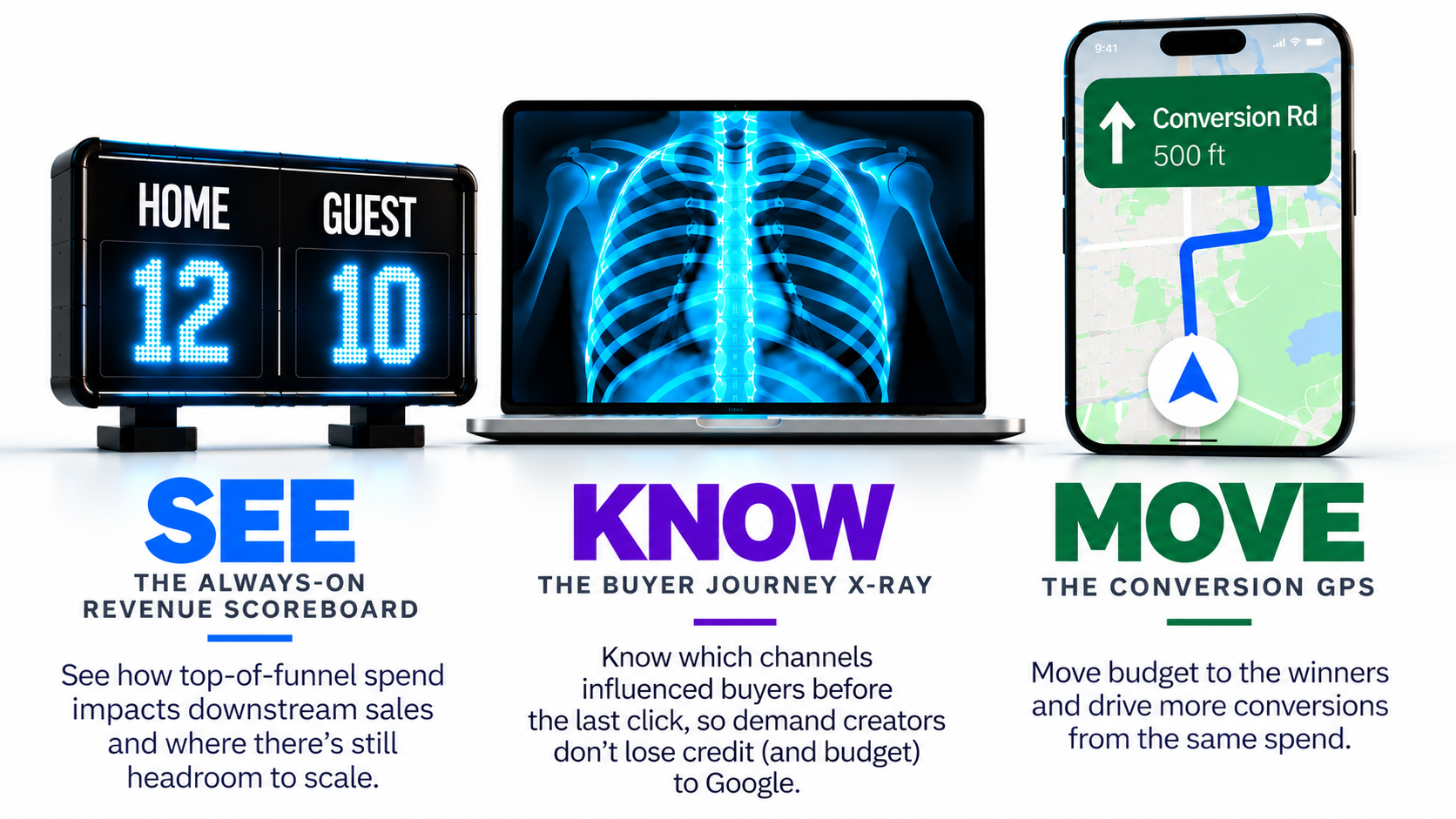
SEE: The Always-On Revenue Scoreboard
Start with the number that matters most.
Revenue.
Blueprint's Impact gives you an always-on scoreboard that helps measure how top-of-funnel advertising investment relates to downstream business results.
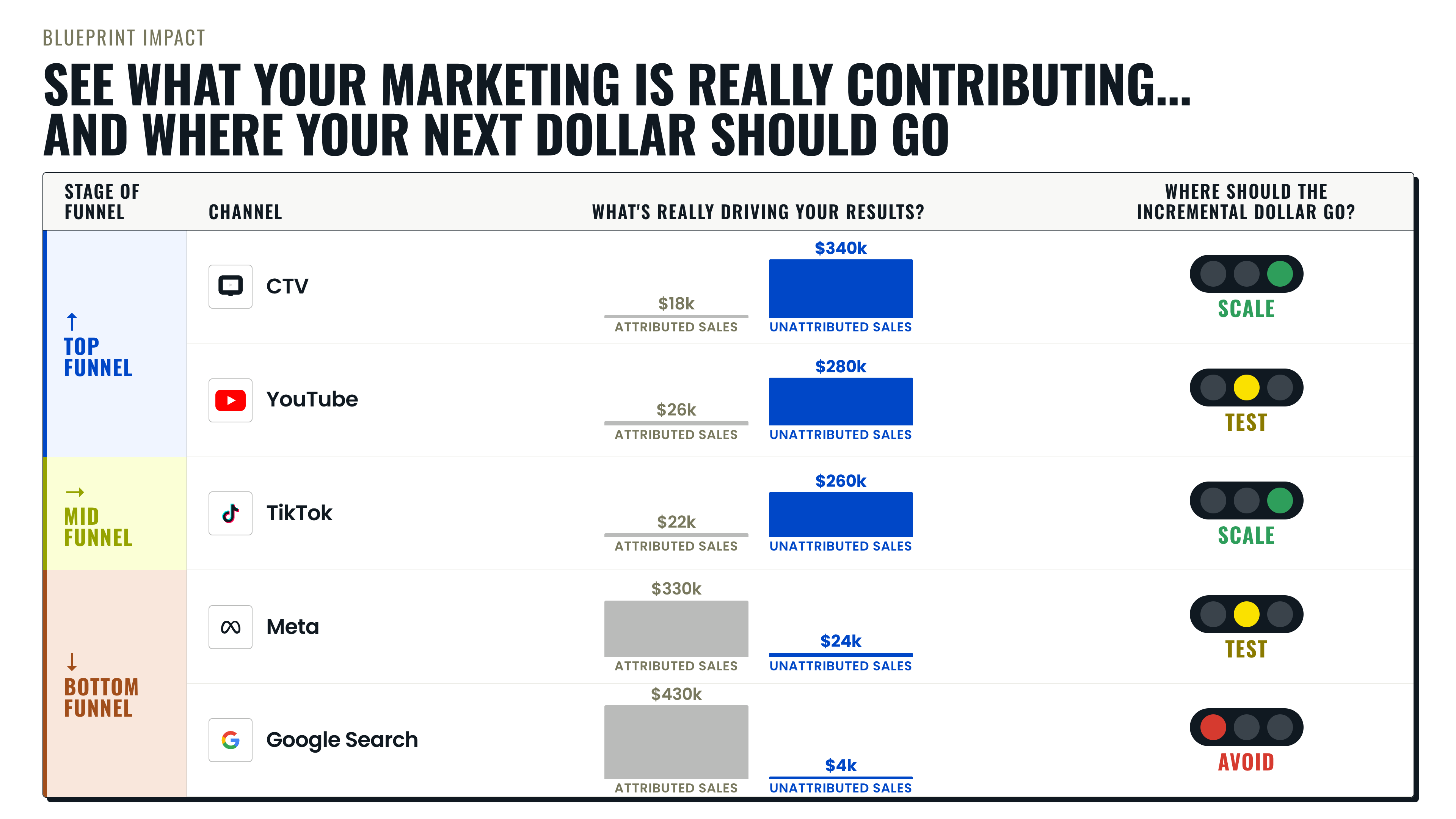
Instead of looking at LinkedIn engagement and hoping it translates into pipeline three to six months later, you can examine how changes in advertising spend relate to qualified opportunities and closed-won revenue, where the connected data supports those outcomes.
Impact works by analyzing the relationship between changes in channel spend and changes in downstream business performance.
That gives you another way to evaluate channels whose contributions may not be fully captured by traditional attribution.
And because the analysis is designed to update as new information comes in, you don't have to treat every budget meeting like another investigation.
You can see what attribution is reporting.
You can examine the additional relationships Impact is revealing.
And you can identify where there may still be room to scale.
Now you have a clearer picture of which investments are associated with business results.
But there's still another question.
How are those buyers actually becoming customers?
KNOW: The Buyer Journey X-Ray
This is where Blueprint's Influence measurement comes in...

Instead of seeing only the channel that received credit for a conversion, you can examine the observable marketing interactions that helped bring the buyer there.
Imagine opening a customer record and seeing that the buyer first encountered your company through LinkedIn.
Then engaged with another campaign.
Later returned through Google.
Eventually became a qualified opportunity.
And finally closed.
Under a last-touch model, Google might receive the credit.
But Influence helps you see the earlier touchpoints that contributed to the journey.
Now you're looking at more than where the customer converted.
You're looking at the marketing activity that helped get them there.
And when you connect those journeys to your CRM, you can examine which channels and campaigns appear in the paths of customers who actually close.
Because a campaign that influences a closed-won customer is worth examining differently from one that generates hundreds of leads that never move forward.
You're no longer judging every channel by its ability to generate the final click.
You're learning which marketing journeys are associated with the customers your sales team is actually winning.
And once you understand those journeys...
You can do something far more valuable than report on them.
MOVE: The Conversion GPS
Here's where Blueprint's Optimizer comes in.
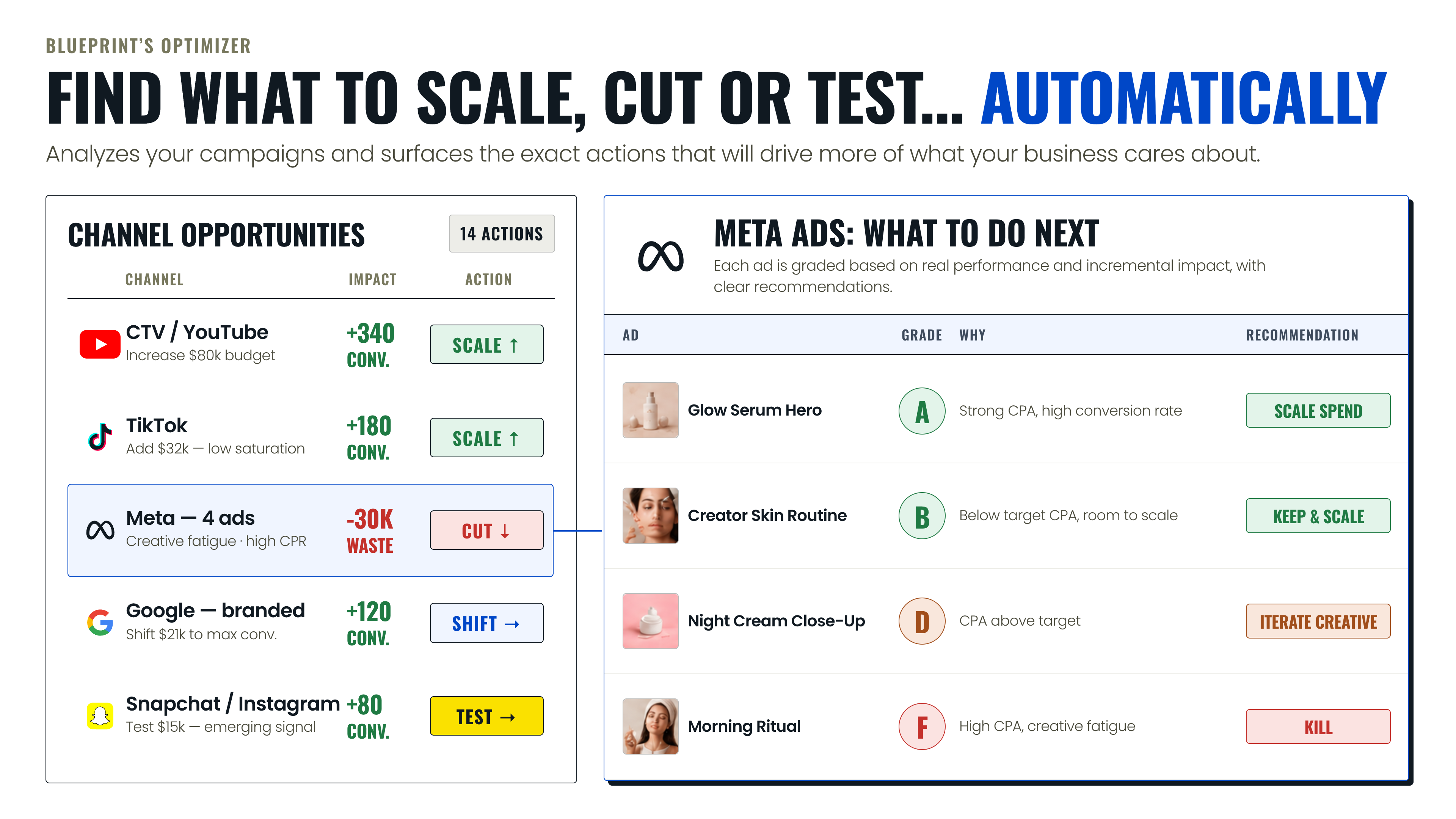
Most advertising teams optimize toward the conversions they can measure most easily.
Leads.
Form submissions.
MQLs.
But there's a big difference between generating more leads and generating more customers.
Your sales team knows this better than anyone.
They don't need another thousand people who downloaded something and never answer the phone.
They need more qualified buyers who resemble the people they're already successfully closing.
And that requires looking beyond the first conversion.
Imagine discovering that one campaign generates leads at half the cost of another.
Normally, that would make it an obvious candidate for additional investment.
But once you connect those campaigns to downstream sales outcomes, you discover that the more expensive campaign is consistently associated with customers who close.
Now you have a much better reason to reconsider where the money belongs.
Blueprint's Optimizer helps use connected downstream conversion data to guide advertising allocation decisions.
Instead of optimizing solely for lead volume or MQLs, you can evaluate campaigns based on their relationship to closed-won customers.
Then use those signals to guide where additional budget should go.
The goal isn't simply to make the advertising dashboard look better.
It's to put more of your marketing dollars behind the campaigns attracting the types of buyers Sales actually converts into customers.
And that's where the three pieces come together.
SEE which advertising investments are contributing to downstream results.
KNOW the journeys that helped turn prospects into customers.
MOVE budget toward the campaigns showing the strongest connection to the customers you want more of.
Now you're managing acquisition with a much clearer understanding of what success actually looks like.
Imagine What Your Next Marketing Meeting Could Look Like
Think about how different your team's conversations would become.
Instead of opening Monday's meeting with a debate about which ads had the highest click-through rates...
You're looking at which campaigns are contributing to qualified pipeline.
Instead of celebrating a lower cost per lead...
You're asking whether those leads resemble the customers your sales team is closing.
Instead of automatically rewarding the channel that received the last click...
You're examining the earlier interactions that helped create the opportunity.
And instead of waiting three to six months, looking at aggregate pipeline and hoping your marketing decisions had something to do with it...
You're using continuously updated measurement to make better-informed decisions as the evidence develops.
That doesn't mean every marketing question suddenly has a perfect answer.
It doesn't mean every conversion can be traced to one specific ad.
And it certainly doesn't mean every change in pipeline was caused by a change in advertising spend.
But it does mean your team can move beyond managing acquisition almost entirely through clicks, engagement and assumptions.
You can start evaluating marketing against the business outcomes that matter.
And using those outcomes to inform what happens next.
That's a much more productive use of your team's time than spending another Monday trying to explain why one dashboard says your campaigns are working while another gives the credit to Google.
Get Updates Like This Monthly
Join our Mailing List
Blueprint Advertising Machine needs the contact information you provide to us to contact you about our products and services. You may unsubscribe from these communications at any time. For information on how to unsubscribe, as well as our privacy practices and commitment to protecting your privacy, please review our Privacy Policy.
Stop Optimizing For The First Conversion. Start Optimizing For The Customers Who Close.
I keep coming back to that marketing leader's admission.
“Maybe we're doing something right.”
There's something revealing about that word.
Maybe.
Because she wasn't questioning whether her team was working hard.
She wasn't questioning whether they could run campaigns.
She was questioning whether they could connect the work they were doing to the results the business actually needed.
And if you can't make that connection, every new budget decision comes with another layer of uncertainty.
Should you spend more on LinkedIn?
Should you shift money toward Google?
Should you scale the campaign generating the cheapest leads?
Or should you invest in the campaign that's attracting fewer prospects but more actual customers?
Those are decisions you shouldn't have to make using engagement metrics and educated guesses alone.
You need to see what's contributing to revenue.
Know which marketing journeys are producing customers.
And move budget based on the outcomes that matter.
Because your job isn't to generate more clicks.
It isn't even to generate more leads.
It's to help the business acquire more customers.
And the closer your advertising decisions get to that outcome, the better positioned your team becomes to deliver it.
FAQ
How can B2B marketers connect advertising spend to closed-won revenue?
B2B marketers can connect advertising platform data with CRM outcomes to evaluate which channels and campaigns are associated with qualified opportunities and closed-won customers. Blueprint combines spend-to-outcome analysis, observable customer journey measurement and optimization capabilities to help teams make advertising decisions based on downstream business results.
Why aren't clicks and MQLs enough to measure advertising performance?
Clicks and MQLs indicate early engagement or lead generation, but they don't necessarily predict which prospects will become paying customers. A campaign with a low cost per lead may produce fewer closed deals than a more expensive campaign that attracts better-qualified buyers. Connecting advertising to CRM outcomes helps marketers evaluate performance against pipeline and revenue.
What is the difference between Blueprint's Impact and Influence?
Impact evaluates statistical relationships between changes in advertising spend and downstream business results. Influence examines observable marketing touchpoints across the buyer journey, helping marketers understand which channels contributed before the final conversion. The two provide complementary views of marketing performance.
Can Blueprint help marketers optimize for closed-won customers instead of MQLs?
Blueprint's Optimizer can use connected downstream conversion signals to inform campaign and budget allocation decisions. Where closed-won customer data is available and supported, marketers can evaluate advertising performance against those outcomes rather than relying exclusively on lead volume or MQLs.
How does Blueprint help teams decide where to move advertising budget?
Blueprint combines information about channel impact, customer journeys and downstream conversion performance to support budget decisions. This helps marketers identify campaigns associated with valuable customers, evaluate where additional investment may be productive and reduce reliance on engagement metrics alone.