


"Allow us to scale up budget on things that we know are working."
That's what one B2B marketing leader wanted.
He wasn't struggling to get campaigns launched.
His team already had seven ads running.
They had a media agency managing the advertising, an established creative strategy, and plenty of technology collecting performance data.
But there was one thing he couldn't do.
Point to an ad and confidently say it deserved more money.
"We've got seven different ads running out there and I don't know which ones are better."
That's a problem.
Because if you can't identify which advertising is producing meaningful business results, you can't confidently decide where to invest more.
You can keep running the campaigns.
You can keep making small adjustments.
You can keep spending the budget you've already committed.
But the moment you want to make a bigger investment, the uncertainty becomes impossible to ignore.
You've hit a Scaling Ceiling.
The Problem Isn't That Your Advertising Has Stopped Working
A Scaling Ceiling occurs when your measurement is good enough to operate an advertising program, but not good enough to confidently scale it.
It's a frustrating place to be.
Because from the outside, everything can look perfectly normal.
Campaigns are active.
Leads are coming in.
The team is reviewing performance.
The dashboards are full of numbers.
Nothing necessarily looks broken.
But there's a difference between having enough information to keep spending and having enough evidence to justify spending more.
And that difference becomes painfully obvious when leadership starts asking where the next investment should go.
Which campaigns are actually helping generate qualified pipeline?
Which creative messages are resonating with the buyers who eventually become customers?
Where should additional budget be allocated to produce the outcomes the business needs?
Those questions are harder than asking which campaign generated the most clicks.
And they become even harder when the sales cycle stretches across months.
For the marketing leader in this story, that was exactly the situation.
His company sold payment automation and corporate card programs to medium-sized and enterprise businesses.
The sales cycle could take six months.
And his measurement wasn't giving him the connection between advertising and downstream results that he needed.
Six Months Later... The Ad That Started The Journey Gets No Credit
Imagine an awareness ad introducing your company to a prospective customer.
The prospect sees the message.
Maybe they visit the website.
Maybe they remember the company when a relevant problem comes up later.
Eventually, they begin evaluating solutions.
And months later, a sales conversation turns into a deal.
Now comes the important question.
Which advertising helped create that opportunity?
If your reporting primarily relies on last-touch attribution, the final recorded interaction may receive the credit.
The earlier advertising can disappear from the story.
That's what frustrated this marketing leader.
"We don't even get an assist on it."
He wasn't asking for credit simply to make marketing look better.
He needed to understand what was working so he could make better decisions about what to fund.
And that's where incomplete attribution becomes a growth problem.
If an awareness ad contributes to future pipeline but receives little credit, you might never recognize that it deserves additional investment.
You might even reduce its budget because the immediate numbers don't look impressive.
Meanwhile, another campaign could appear to be performing beautifully because it generates inexpensive leads.
But what if those leads rarely become qualified opportunities?
Which campaign should receive the next $50,000?
The one producing the cheapest leads?
Or the one associated with more valuable downstream activity?
Without the right measurement, you're making that decision with an incomplete picture.
That's why marketing can spend six months creating demand while sales gets all the credit.
But the bigger consequence isn't attribution credit.
It's that the company may be allocating money away from the advertising that could help it grow.
Three Systems... And Still No Clear Answer
This wasn't a company that lacked marketing technology.
It had Salesforce.
Marketo.
6sense.
And advertising running across multiple platforms.
Yet the marketing leader described a familiar problem.
"They all don't talk to each other."
The advertising platforms reported one version of performance.
The marketing systems recorded another part of the journey.
Salesforce held the downstream business outcomes.
But the connections between those systems weren't giving the team a clear understanding of which advertising was contributing to those outcomes.
So even with all that technology, the question remained unanswered.
Where should the next dollar go?
That's the real problem with the Scaling Ceiling.
You have enough data to manage the existing program.
But not enough connected evidence to make confident allocation decisions.
And there's an important distinction between the metrics advertising platforms emphasize and the outcomes leadership actually cares about.
Meta might show strong engagement.
Google might report an attractive ROAS.
LinkedIn might generate leads at a certain cost.
Those metrics can be useful.
But leadership isn't necessarily trying to maximize engagement, ROAS, or lead volume.
Leadership might need more qualified opportunities.
More closed revenue.
Greater acquisition efficiency.
Or stronger growth in a particular market.
And the advertising that performs best against those objectives may not be the same advertising that looks best inside an individual platform.
Why Better Attribution Is Only Half The Solution
The obvious answer is to connect the systems and improve attribution.
And that's an important first step.
You need to understand how advertising activity relates to the business outcomes happening further down the funnel.
But imagine you've solved that problem.
You can see more of the customer journey.
You have a better understanding of which campaigns are influencing qualified opportunities and revenue.
Now what?
Someone still has to decide how to allocate the budget.
Which campaign gets more money?
Which one gets less?
Which creative deserves another test?
And how should those decisions change when leadership's priorities change?
That's where a better dashboard alone can leave you short.
Because seeing the numbers isn't the same as knowing what to do with them.
The Scaling Ceiling is ultimately a decision problem, not just a measurement problem.
You don't simply need to know what happened.
You need to know where the money should go next.
And those recommendations need to be connected to the outcomes the business is trying to achieve.
Not simply whichever platform is reporting the most attractive numbers.
The Best ROAS Doesn't Always Mean The Best Investment
Suppose you're running two campaigns.
Campaign A generates an impressive platform-reported ROAS.
Campaign B looks less efficient inside the advertising dashboard.
If you optimize purely for ROAS, Campaign A gets more money.
But what if Campaign A is primarily capturing demand from buyers who were already close to purchasing?
And what if Campaign B is helping introduce the company to prospects who eventually become valuable customers?
Now the decision gets more interesting.
If leadership wants to maximize immediate attributed revenue, Campaign A might deserve the investment.
But if the business needs to build more qualified pipeline for future quarters, Campaign B could be worth testing with additional budget.
The same problem appears with creative.
One message might produce a high volume of inexpensive leads.
Another might generate fewer leads but be associated with stronger sales opportunities.
Which message deserves more money?
That depends on what the business needs.
And that's precisely why optimizing exclusively for clicks, impressions, or platform ROAS can lead to the wrong allocation decisions.
Those metrics tell you something about advertising performance.
They don't necessarily tell you which investment will best support the company's next stage of growth.
That's the distinction behind optimizing B2B advertising for closed sales instead of leads.
And it's where Blueprint Optimizer changes the conversation.
How Blueprint Optimizer Turns Measurement Into Budget Decisions
Blueprint starts by connecting the advertising and business systems a company already uses.
Instead of treating Meta, Google, and other advertising platforms as separate sources of truth, it brings their information together with analytics and downstream business outcomes.
That creates a unified measurement view.
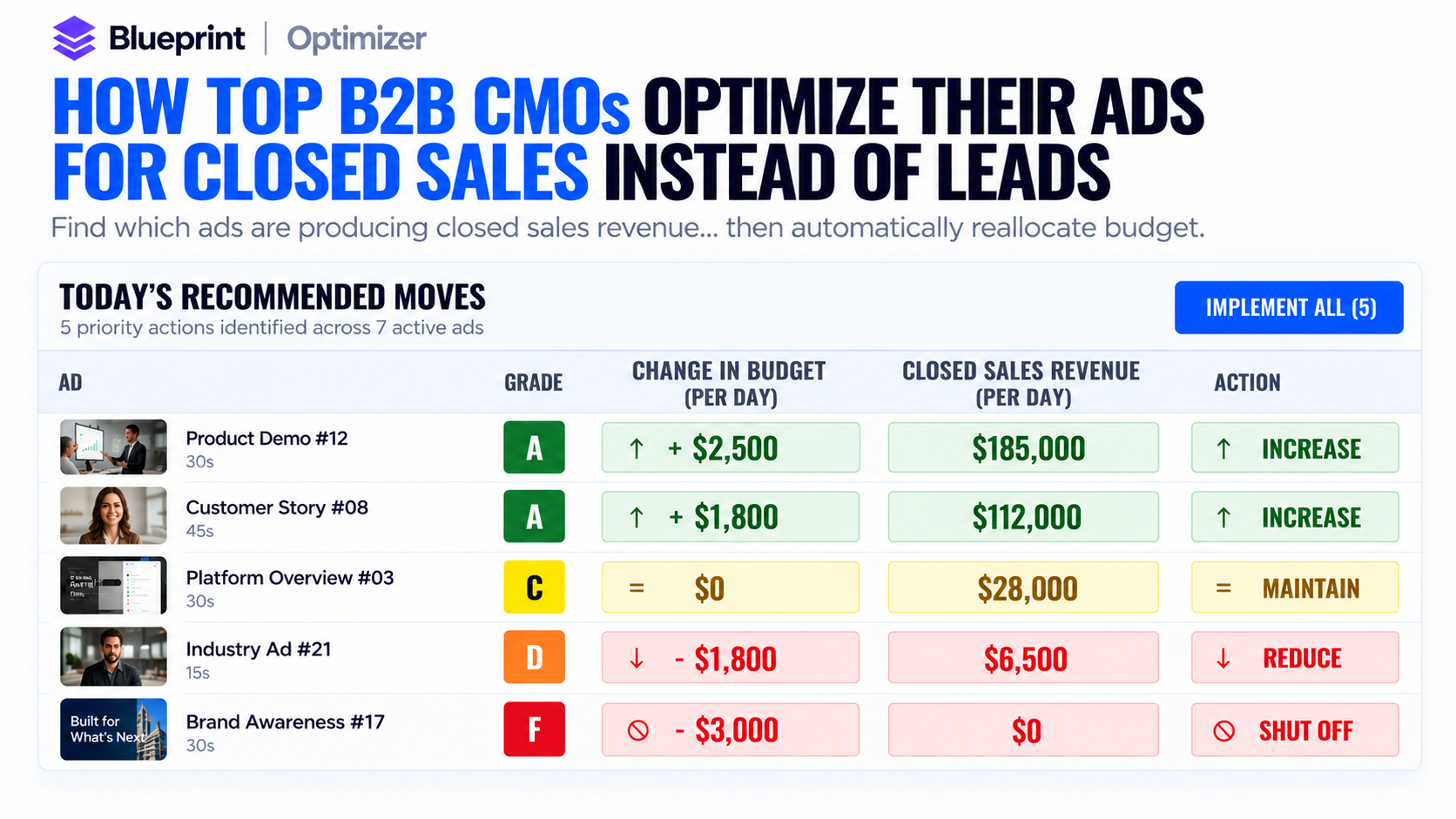
A company can examine how advertising activity relates to qualified leads, sales opportunities, and revenue, rather than relying exclusively on the performance reported by each platform.
Blueprint's influence measurement also helps reveal advertising that may have contributed to a buying journey without receiving the final attribution credit.
That's particularly important for awareness advertising and long B2B sales cycles.
But connecting the data is only the beginning.
Optimizer takes that measurement and turns it into recommendations about how advertising budget should be allocated.
And the important distinction is what those recommendations are based on.
Instead of simply chasing the highest ROAS or lowest cost per click, Optimizer uses connected performance and business-outcome data to help identify where advertising investment may be more valuable.
If leadership needs more qualified pipeline, that objective should inform how campaigns are evaluated.
If the business needs greater revenue efficiency, the allocation decisions should reflect that goal.
If the priority is growth, the team needs to understand where additional investment has the strongest supporting evidence.
Optimizer can evaluate opportunities to reallocate spending across campaigns and ad sets, with more granular decisions where the connected data supports them.
It can also support pushing those decisions back into advertising platforms.
That changes the role of measurement.
Instead of presenting a collection of numbers and leaving the team to figure out what they mean, the system helps translate performance into allocation recommendations.
The marketing team can evaluate those recommendations, make changes, and monitor the downstream results.
No recommendation guarantees that increasing spending will produce incremental revenue.
But it gives the team a more informed basis for deciding where to invest.
And that's the missing link between operating an advertising program and confidently scaling it.
The Next Budget Decision Should Start With What Leadership Needs
Imagine your CMO wants more qualified pipeline next quarter.
The media buyer looks at the advertising dashboards and sees which campaigns generated the cheapest leads.
That's useful information.
But it isn't necessarily the answer to the CMO's question.
What if the cheapest leads rarely become sales opportunities?
What if a more expensive campaign is associated with prospects who move further through the buying journey?
And what if some of the advertising contributing to those opportunities is being overlooked by last-touch attribution?
Those distinctions can change where the next dollar belongs.
With advertising data connected to downstream outcomes, Optimizer can help evaluate allocation opportunities against the business objective.
That might mean recommending more investment in a campaign associated with stronger qualified pipeline.
It might mean reducing spending on activity that looks efficient in the platform but contributes less to the desired result.
Or it might mean identifying a creative approach worth testing with additional budget.
The business objective should determine how you allocate advertising dollars... not the other way around.
And when leadership's priorities change, the way you evaluate advertising should be able to change with them.
That's how measurement becomes useful for growth rather than just reporting.
"It Would Give Us A Consistent Strategy"
When the marketing leader was asked what better measurement would allow him to do, his answer revealed how much opportunity he believed was being held back.
"It would give us a consistent strategy."
He talked about making more educated decisions.
Experimenting with greater confidence.
Taking what he called "shots downfield for bigger plays."
And then he came back to the outcome that mattered most.
"Allow us to scale up budget on things that we know are working."
That's the difference between maintaining a marketing program and building one you can confidently grow.
You stop making budget decisions solely because one platform reports better numbers than another.
You start evaluating advertising against the outcomes the business actually needs.
You identify promising opportunities.
You test them.
You learn from the results.
And when the evidence supports it, you increase investment.
That doesn't mean eliminating uncertainty.
It means making the next decision with more information than the last one.
It's also why a marketing program can hit an acquisition ceiling even when its campaigns are still performing.
The advertising may be generating results.
But without enough evidence to determine where additional money belongs, growth remains constrained.
Get Updates Like This Monthly
Join our Mailing List
Blueprint Advertising Machine needs the contact information you provide to us to contact you about our products and services. You may unsubscribe from these communications at any time. For information on how to unsubscribe, as well as our privacy practices and commitment to protecting your privacy, please review our Privacy Policy.
Your Next Stage Of Growth Might Already Be Running
Somewhere inside your existing advertising program, there may be a campaign that deserves more budget.
A creative message that resonates with your most valuable buyers.
An awareness campaign that's contributing to qualified pipeline but receiving little attribution credit.
Or an opportunity to move money away from weaker activity and toward something more promising.
The frustrating part is that you may already be collecting the data needed to investigate those opportunities.
It's just scattered across advertising platforms, analytics, and business systems.
And until that information is connected to the outcomes leadership actually cares about, your team is left making allocation decisions with an incomplete picture.
For the marketing leader in this story, better measurement represented the possibility of doing something he couldn't confidently do before.
Increase investment behind the advertising that deserved it.
You have campaigns running.
You have money being spent.
And you may have an opportunity to scale.
The question is whether your measurement can tell you where that next investment belongs.
Because your next stage of growth may not require another campaign.
It may require knowing which of the campaigns you're already running deserves more money...
FAQ
What is a Scaling Ceiling in marketing?
A Scaling Ceiling occurs when a company's marketing measurement is good enough to operate existing campaigns but not good enough to confidently increase investment. The team can monitor advertising performance and make routine adjustments, yet struggles to identify which campaigns deserve more budget based on downstream business outcomes.
Why can a company have strong advertising metrics but still struggle to scale?
Advertising platforms typically emphasize metrics such as clicks, conversions, cost per lead, and ROAS. Those numbers may not show how advertising contributes to qualified pipeline, closed revenue, or other leadership priorities. Without that connection, marketers can struggle to justify larger investments.
How does Blueprint Optimizer help companies overcome a Scaling Ceiling?
Blueprint Optimizer uses connected advertising and downstream business-outcome data to inform budget allocation recommendations. It helps marketers identify opportunities to increase, reduce, or redistribute spending based on the outcomes the business is trying to achieve rather than relying exclusively on platform-reported performance.
How is optimizing for business outcomes different from optimizing for ROAS?
ROAS measures attributed revenue relative to advertising spending. Business-outcome optimization evaluates advertising against the company's actual objectives, such as qualified pipeline, revenue growth, or acquisition efficiency. The campaign with the highest reported ROAS may not be the best investment for every business goal.
Can Blueprint Optimizer guarantee better results when advertising budgets increase?
No. Optimizer provides evidence-informed recommendations, not guaranteed incremental revenue. Marketing teams should evaluate the recommendations, monitor downstream performance after making changes, and continue testing as new information becomes available.