


“We've got seven different ads running out there and I don't know which ones are better.”
That's what one B2B marketing leader told us when we asked about the biggest frustration in his advertising program.
He was responsible for developing the advertising and messaging strategy.
His company was investing heavily in marketing.
The campaigns were running.
The creative was getting produced.
And every day, the advertising budget kept moving.
But when it came to the one outcome that ultimately mattered...
Which ads were actually helping produce closed sales?
He didn't have a clear answer.
And for someone responsible for deciding where advertising money goes, that's an uncomfortable position to be in.
Because the budget doesn't stop moving just because the measurement isn't working.
You still have to approve the next campaign.
Decide which creative to keep running.
Determine where to increase spending.
And explain why those decisions make sense.
All while knowing that the advertising you're cutting today might be contributing to a sale that won't close for another six months.
The anxiety of making expensive decisions without knowing what's working
Here's what makes this problem particularly difficult for B2B marketing leaders.
You can have plenty of marketing data and still have very little confidence in your decisions.
Meta can tell you how your ads are performing.
LinkedIn can report engagement and conversions.
Google can show you which campaigns generated activity.
Your marketing automation platform can tell you what happened to leads.
And your CRM can tell you which opportunities eventually closed.
But none of those reports necessarily gives you the complete answer to the question you're being paid to answer.
Which advertising investments are producing closed sales?
For this particular marketing leader, the problem was compounded by a long enterprise sales cycle.
Someone might encounter an ad today.
See another campaign a few weeks later.
Become familiar with the company over several months.
Eventually talk to Sales.
And six months later, become a customer.
But when that sale finally closes?
“Sales takes all, all the credit and we can't put that back to do any of the advertising. We don't even get an assist on it.”
So the marketing leader is left trying to make tomorrow's advertising decisions without a clear picture of what yesterday's advertising contributed.
That's where the anxiety comes from.
Not because he doesn't know how to create advertising.
But because he can't confidently determine whether the advertising he's creating is working.
You can't optimize what you can't connect to closed sales
The company wasn't short on technology.
It had Salesforce.
Marketo.
6sense.
And advertising running across major platforms.
The problem was that the systems weren't connected well enough to tell one consistent story.
“We've got Salesforce, we've got 6 Sense, we've got Marketo. They all don't talk to each other.”
That creates an enormous amount of work between running an ad and understanding what it accomplished.
And even after pulling the reports together, the team still might not know which creative deserves more investment.
“I would like to be able to just say, hey, this creative is performing X better than the last creative.”
Then he explained what was missing:
“I need to be able to track it through the whole funnel.”
That's the critical distinction.
He didn't simply need to know which ad generated another lead.
He needed to understand what happened after that lead entered the business.
Did the account become a sales opportunity?
Did it move through the sales process?
Did it eventually become a customer?
And how did the advertising contribute along the way?
Because an ad that generates 100 leads but no closed sales isn't necessarily a better investment than one that generates 20 leads and helps bring in valuable customers.
Yet when marketing is judged on revenue but can only prove clicks, that's exactly the kind of mistake the measurement system can encourage.
The most dangerous ad to cut might be the one helping create your next customer
Consider what happens when an ad is doing its job early in a six-month buying journey.
It's introducing the company to the right people.
Helping them understand a problem.
Giving them a reason to remember the brand.
But it's not generating immediate leads.
Meanwhile, another ad reaches buyers much later, when they're already looking for a solution.
That second ad generates the conversion.
And gets the credit.
So when the CMO reviews performance, the decision can look obvious.
Increase spending on the ad producing leads.
Reduce spending on the one that isn't.
Except there's something missing from that conclusion.
The first ad may have helped create the demand that the second ad captured.
Or it may not have.
That's precisely why better measurement matters.
Without visibility into how advertising participates in the customer journey, you can't confidently distinguish an underperforming ad from one whose contribution simply isn't visible in last-touch reporting.
It's why most top-of-funnel ads can help create pipeline but not get any of the credit.
And it becomes particularly expensive when those incomplete numbers are used to decide which campaigns to scale and which to shut off.
What if your advertising could be optimized for closed sales instead?
This is where Blueprint Optimizer changes the decision-making process.
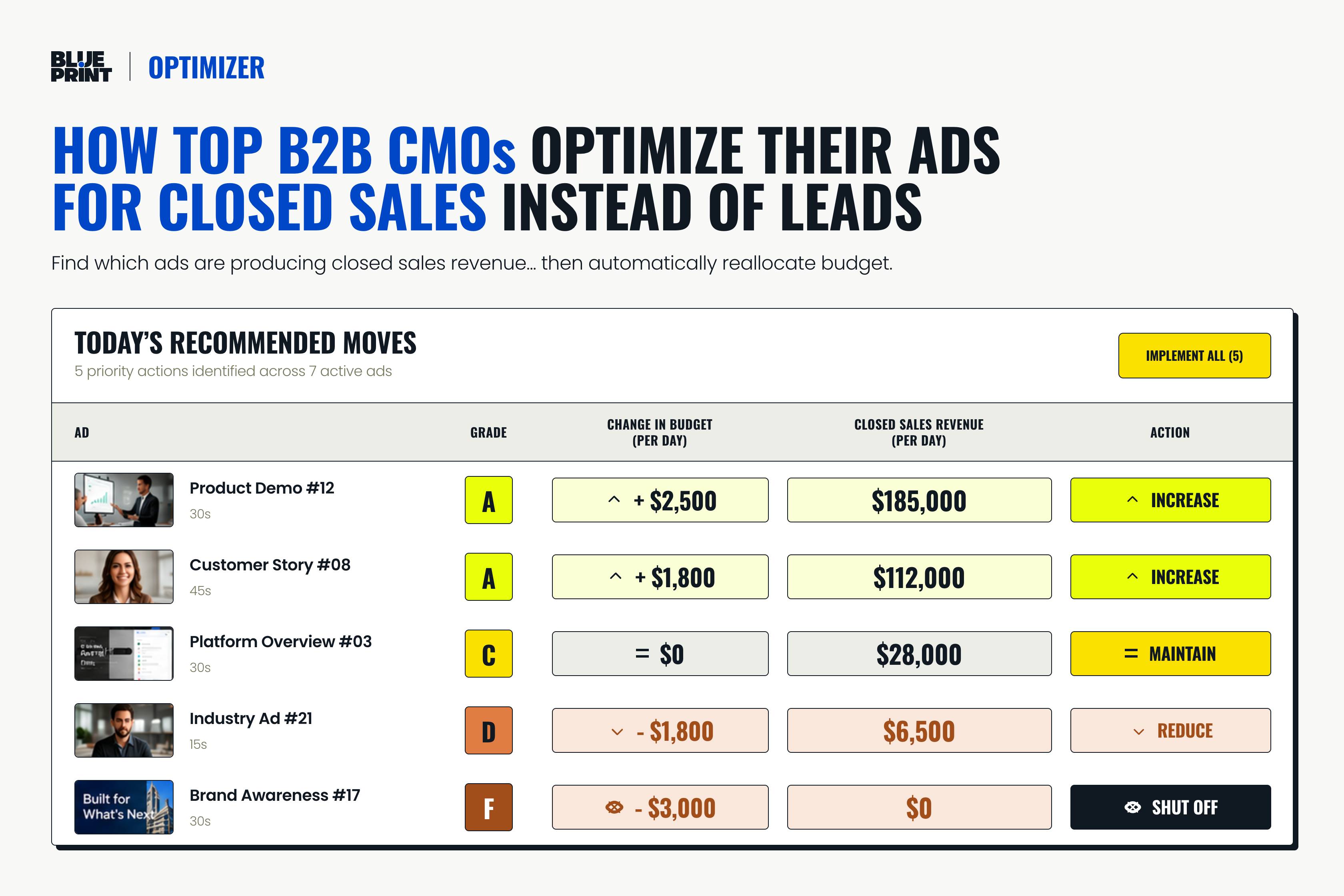
Instead of stopping at the metrics inside each advertising platform, Blueprint connects marketing activity with downstream business outcomes.
Including the closed sales recorded in your CRM.
That creates the foundation for a different approach to optimization.
Rather than asking which ads are generating the most leads, you can evaluate which advertising investments are contributing to closed sales.
Blueprint brings together advertising performance, attribution and observed customer-journey influence to help marketers understand how campaigns and creatives participate in the sales process.
Its Optimizer then uses the available performance information to surface recommendations about where budgets may deserve to increase, decrease or stop.
The marketer can review the recommendation, understand the reasoning and decide whether to implement it.
And that's an important distinction.
Blueprint isn't claiming that every closed sale can be traced to one ad with perfect certainty.
Nor does observing an ad in a buyer's journey prove that the ad caused the sale.
But connecting advertising activity to downstream sales outcomes gives the CMO more relevant evidence than optimizing exclusively around clicks or lead volume.
It's a way to move beyond attribution that is directionally useful but not precise enough for confident budget decisions.
Because the goal isn't simply to generate more activity.
It's to invest more intelligently in the advertising that helps the business acquire customers.
From another reporting exercise to today's recommended moves
Imagine opening your marketing measurement platform tomorrow morning.
Instead of spending hours trying to reconcile advertising reports with your CRM, you see a set of specific recommendations.
Increase the budget on this creative.
Reduce spending on that campaign.
Maintain this one.
Investigate an ad that appears weak in platform attribution but shows meaningful participation in customer journeys that eventually close.
And beside each recommendation is the business outcome you're actually trying to improve.
Closed sales revenue.
Not another engagement metric.
Not a lead count disconnected from the sales process.
Not a platform's self-reported ROAS.
The revenue associated with actual closed sales.
For a B2B company investing tens of millions annually in advertising, that changes the question.
Instead of asking which campaign produced the most activity, the CMO can ask:
Where should the next advertising dollar go to improve closed-sales performance?
And instead of relying entirely on historical reports, the team has a decision-support system designed to help turn measurement into action.
That's the promise behind Blueprint Optimizer.
Connect the advertising to the business outcomes that matter.
Identify where performance may justify a different allocation.
And help the marketer act on those findings faster.
Get Updates Like This Monthly
Join our Mailing List
Blueprint Advertising Machine needs the contact information you provide to us to contact you about our products and services. You may unsubscribe from these communications at any time. For information on how to unsubscribe, as well as our privacy practices and commitment to protecting your privacy, please review our Privacy Policy.
The six-month sales cycle doesn't disappear... But the blind spot can get smaller.
A company with a six-month sales cycle still has a six-month sales cycle.
No optimization platform can make every advertising decision immediately measurable against a sale that hasn't happened yet.
But that doesn't mean the CMO has to remain stuck with the same incomplete view.
As closed-sales data becomes available, it can inform how earlier advertising activity is evaluated.
And when that information is connected with the rest of the marketing data, the team has a better basis for making future decisions.
The objective isn't to eliminate uncertainty.
It's to replace as much unnecessary uncertainty as possible with evidence.
For the marketing leader we spoke with, that was the missing piece.
He had the ads.
He had the systems.
He had the responsibility.
What he didn't have was a clear enough connection between the advertising he controlled and the sales outcomes the company cared about.
And that's what made every optimization decision harder than it needed to be.
Stop optimizing for the easiest number to measure
There's a reason B2B marketers keep coming back to leads.
They're relatively easy to count.
They happen much sooner than closed sales.
And they give everyone something to report while the sales cycle plays out.
But easy to measure doesn't always mean useful to optimize.
A campaign can look fantastic at generating leads while producing little closed business.
Another can look mediocre in the advertising dashboard while participating in journeys that eventually become valuable customers.
If your optimization process can't distinguish between those situations, you may be systematically rewarding the wrong advertising.
That's why funding the channels that are easiest to measure instead of the ones helping create growth is such a dangerous habit.
The better question isn't simply how many leads your advertising produced.
It's how your advertising is contributing to the customers your business actually closes.
And what you should do differently because of that information.
For a CMO making decisions about millions in advertising spend, that's the difference between having another dashboard and having a clearer path forward.
You don't need to keep guessing which ads deserve more money.
You need to connect the advertising to closed sales, understand the evidence behind each recommendation and make your next budget decision with greater confidence.
FAQ
How can B2B companies optimize advertising for closed sales instead of leads?
B2B companies can connect advertising data with CRM records of closed sales, then evaluate campaigns and creatives using downstream business outcomes rather than lead volume alone. This gives marketing teams a stronger basis for deciding where to increase, decrease or maintain advertising investment.
Why is optimizing B2B advertising for leads alone a problem?
Lead volume does not necessarily reflect the number or value of customers a company eventually acquires. An ad can generate inexpensive leads that rarely become customers, while another may contribute to fewer leads but more valuable closed sales. Optimizing exclusively for lead generation can therefore encourage spending on campaigns that don't produce the best business outcomes.
How does Blueprint Optimizer help B2B marketers allocate advertising budgets?
Blueprint Optimizer uses connected marketing performance data to identify opportunities to adjust advertising budgets. It can surface recommendations about which campaigns or ads may deserve more investment, reduced spending or further investigation. Marketers can review the reasoning and decide which recommendations to implement.
Can you connect B2B advertising to closed sales with a six-month sales cycle?
Yes, advertising interactions can be connected with downstream CRM outcomes when the necessary data and identifiers are available. However, long sales cycles introduce reporting delays and attribution uncertainty. A closed sale may reflect several advertising and non-advertising interactions, so observed influence should not be mistaken for proof that a particular ad caused the sale.
What's the difference between optimizing for MQLs, SQLs and closed sales?
MQLs and SQLs measure earlier stages of the buying process, while closed sales represent completed customer acquisitions. Optimizing for closed sales aligns advertising evaluation more directly with realized business outcomes, although MQLs and SQLs can still provide useful early indicators while opportunities move through a lengthy sales cycle.