


"We've got seven different ads running out there and I don't know which ones are better."
Seven ads.
Seven different opportunities to learn what was resonating with buyers.
And the person responsible for creating them couldn't tell which one deserved more money.
He wasn't lacking ideas.
He had plenty of those.
So did everyone else.
"We have a lot of opinions internally," he explained.
And when the team couldn't tell which messages were producing results, those opinions started shaping the creative strategy.
"We're opinion driven. So the opinion of the day isn't necessarily the thing that's going to drive revenue. It's just the opinion of the day and it changes."
There's the problem.
When nobody can prove which ads are working, the next campaign becomes another guess.
Someone suggests a different headline.
Someone wants a new message.
Someone thinks the brand should try something else.
And maybe they're right.
But nobody has the evidence to know.
So the strategy changes.
Then changes again.
Meanwhile, the ads already running might be doing exactly what they were supposed to do.
Only nobody can prove it.
The Problem Isn't Too Many Opinions
You want people challenging the advertising.
Sales hears things from prospects that marketing should know.
Your CMO sees opportunities the creative team might miss.
And good creative people should constantly question whether there's a better way to communicate the message.
But there's a difference between using those opinions to generate ideas and allowing them to determine the strategy.
The missing piece is evidence.
Because when you can't connect your advertising to business outcomes, everyone can make a convincing argument.
And no one can settle it.
The person responsible for creative ends up defending one opinion against another.
That's why the loudest opinion can win when nobody knows which ads drive revenue.
But the larger problem is what happens to the company's ability to learn.
Each new campaign becomes another experiment.
Another creative direction.
Another round of messaging.
Yet the team never builds a reliable understanding of which messages deserve to be repeated.
So instead of developing a consistent advertising strategy, it keeps starting over.
And the more advertising you run, the more expensive that uncertainty becomes.
Six Months Later... Sales Gets All The Credit
The marketing leader in this story worked for a B2B company selling payment automation and corporate card programs.
Their customers were medium-sized and enterprise businesses.
The buying journey could take six months.
That meant an ad might introduce a prospect to the brand today.
Another message could reinforce the company's value a few weeks later.
And months after that, the prospect might finally speak to sales.
By the time the deal closed, the original creative could be a distant memory.
"We don't even get an assist on it."
Sales received the credit.
The advertising that helped create awareness and consideration wasn't reliably connected to the result.
And that creates a much bigger problem than an incomplete marketing report.
It means the creative that helped create a customer can look like a loser.
Imagine trying to decide which message deserves another $50,000 when the results of the first $50,000 aren't visible.
You might abandon a message that's helping bring valuable buyers into the funnel.
Or scale a different one because it generates more immediate clicks.
And when someone suggests a new creative direction, you have no reliable evidence to explain why the existing one deserves more time.
That's how marketing can spend six months creating demand while sales gets all the credit.
The consequences don't end with attribution.
They influence what the company decides to create next.
Three Systems... And Still No Clear Answer
This company wasn't short on marketing technology.
It used Salesforce, Marketo, and 6sense.
Its advertising ran across multiple platforms.
Yet the marketing leader described the internal systems as disconnected.
"They all don't talk to each other."
And the company tended to rely on last-touch attribution.
So the advertising platforms could show clicks and conversions.
Marketing systems could show leads and engagement.
Salesforce could show opportunities and revenue.
But the connection between the creative messages and those downstream outcomes remained unclear.
That's the structural problem.
The system measures pieces of the buying journey without giving the creative team a reliable view of how those pieces relate.
A creative message might generate plenty of clicks but attract buyers who never become qualified opportunities.
Another might produce fewer immediate responses but help introduce the brand to people who later become valuable customers.
If the team only looks at platform performance or the final recorded touch, those differences may never become visible.
And without that information, how can you confidently choose what to test next?
You can't reliably identify which messages deserve more variations.
You can't tell which creative themes are contributing to the sales pipeline.
And you can't justify increasing budget behind a particular approach.
So the next creative decision becomes another judgment call.
Which brings everyone else's opinions right back into the conversation.
Why More Creative Testing Doesn't Solve The Problem
The obvious answer is to run more tests.
Try another headline.
Another video.
Another message.
Another audience.
But testing only makes your strategy better when you can learn something useful from the results.
If you're judging awareness advertising by immediate conversions, you may reject a message before its contribution becomes visible.
If you're judging creative entirely by engagement, you may favor the ad that gets attention over the one associated with qualified buyers.
And when the sales cycle lasts six months, the results you care about may arrive long after the original creative test.
So you keep experimenting.
But the experiments don't necessarily make your next decision any easier.
That's the difference between running tests and building a strategy.
A strategy gets stronger as you learn.
You identify what works.
You understand why it might be working.
You develop variations.
And you use the results to decide where to invest next.
But without a feedback loop that connects creative to meaningful downstream outcomes, that learning process breaks down.
The marketing leader was clear about what he wanted.
He wanted to understand which brand messages were resonating and how they affected downstream activity.
Not which ad people liked most.
Not which creative received the most attention.
Which messages were helping move buyers toward revenue.
The Better Question Is Which Creative Is Creating Business Value
For B2B advertisers, the answer requires looking beyond the initial click.
You need to examine how advertising activity relates to qualified leads, sales opportunities, and eventually revenue.
That doesn't mean every sale can be perfectly assigned to one ad.
A long buying journey can involve multiple people, channels, and interactions.
Some influences won't be observable.
But you can build a more useful picture of performance than the one provided by last-touch attribution alone.
Suppose one creative message generates twice as many leads as another.
At first glance, it looks like the winner.
But what if those leads rarely become qualified opportunities?
And what if the second message is associated with fewer leads but more valuable pipeline?
That changes the decision.
The first creative may still have a role.
But the second deserves closer attention.
Perhaps it speaks more directly to a serious buying problem.
Perhaps it attracts a more valuable audience.
Perhaps it's effective at a different stage of the buying journey.
Now the next test has a purpose.
You're no longer guessing which creative direction sounds best.
You're investigating which message is associated with the outcomes your business actually values.
That's the logic behind optimizing B2B ads for closed sales instead of leads.
Because the creative strategy should learn from what happens after the click, not just what happens immediately before it.
How Blueprint Connects Creative Performance To Downstream Results
Blueprint addresses this by connecting the advertising and business systems companies already use.
Rather than relying on disconnected platform reports, it brings advertising data, analytics, and downstream CRM information into a unified measurement view.
The information is cleaned and normalized so the team can evaluate performance across channels using more consistent definitions.
For a B2B advertiser using Meta, LinkedIn, Google, Marketo, and Salesforce, that changes the questions the team can investigate.
Instead of looking only at what each advertising platform reports, marketers can examine how advertising activity relates to leads, qualified opportunities, and revenue.
Blueprint's influence measurement adds another perspective.
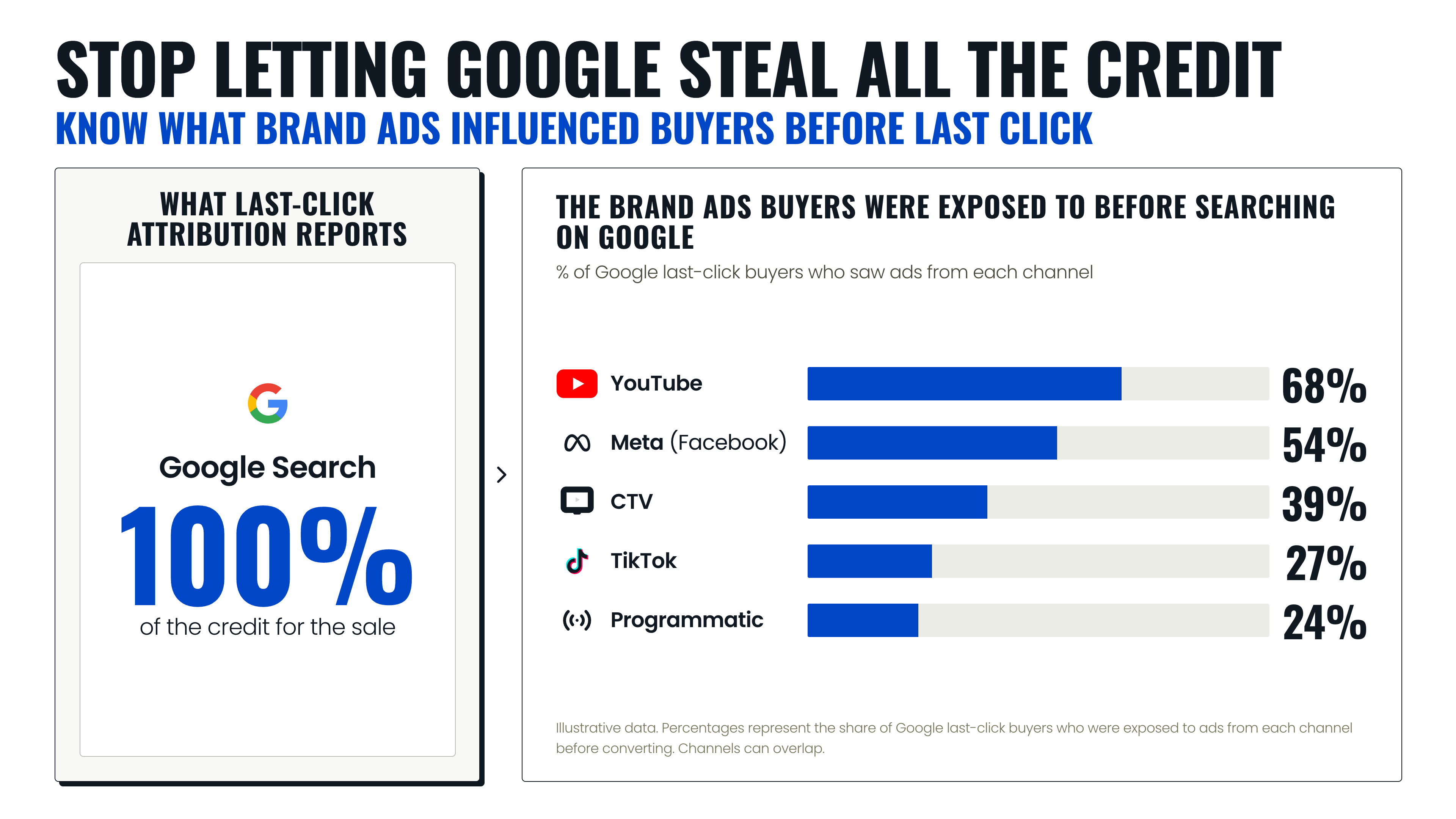
It helps reveal advertising that may have contributed to the buying journey without receiving the final conversion credit.
That's especially relevant for awareness campaigns.
An ad that introduces a prospect to the brand may not be the last interaction before a sale.
But that doesn't mean it had no influence.
And Blueprint's broader impact analysis can help examine statistical relationships between channel investment and business outcomes.
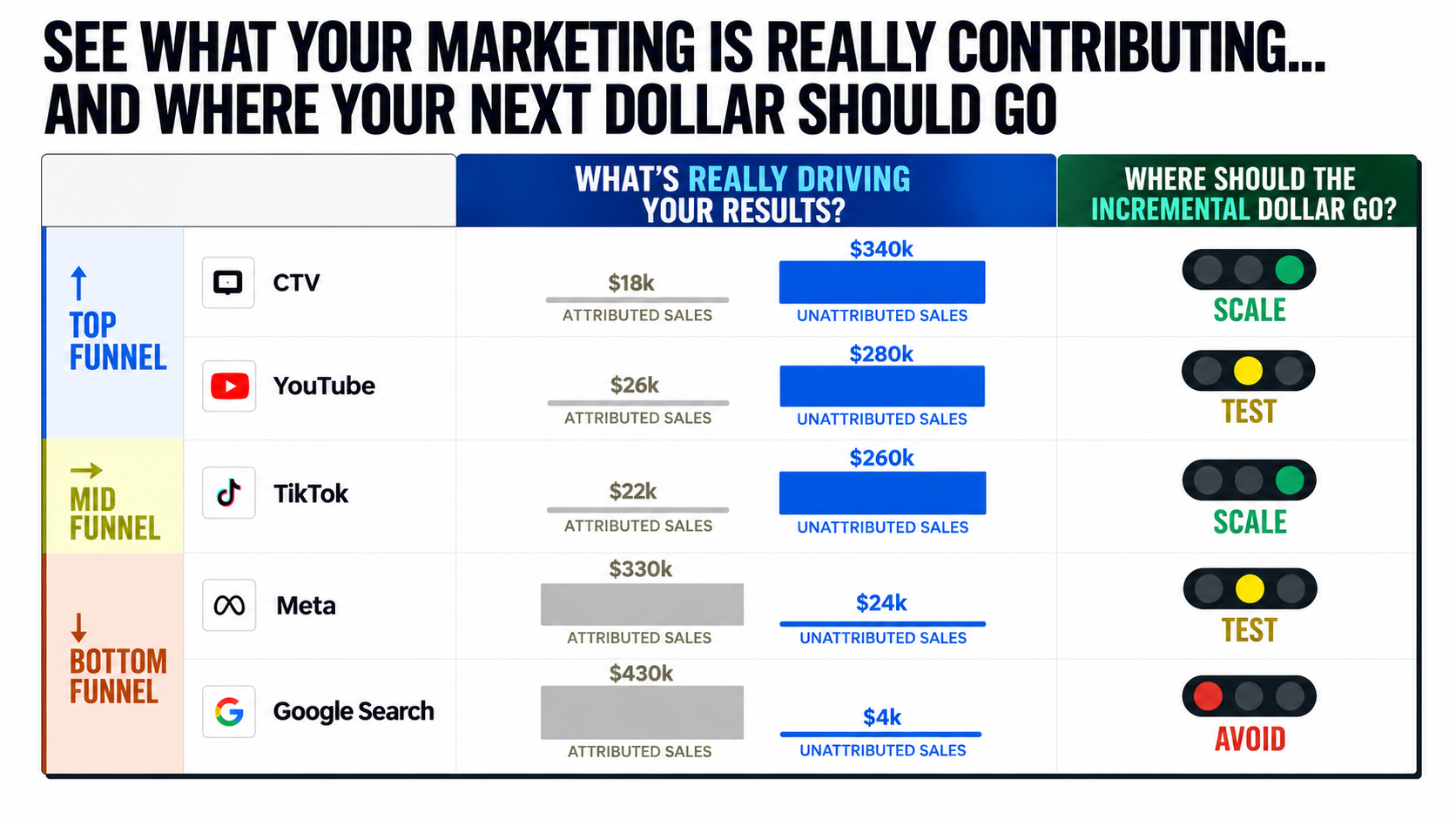
These perspectives aren't interchangeable.
An observed interaction doesn't prove an ad caused a sale.
A statistical relationship doesn't automatically establish incrementality.
But the combination can give marketers a stronger basis for evaluating which creative approaches deserve further investigation and testing.
That's what makes the difference.
You're no longer limited to asking which ad generated the most clicks.
You can begin asking which messages are associated with valuable downstream activity.
And what that means for the next creative decision.
"Why Wouldn't It Just Be Another Platform We Have?"
The marketing leader raised a reasonable objection during the conversation.
"Why wouldn't it just be another platform we have?"
He already had multiple systems.
And he was concerned that adding another platform might create even more confusion.
But his problem wasn't a lack of data.
It was the inability to connect that data into a useful answer.
Blueprint connects to the existing advertising platforms, analytics environment, and CRM systems.
It brings that information into a common view so the team can examine advertising performance across the buying journey.
That matters because the goal isn't another report.
It's the ability to make a decision.
Which creative messages deserve another test?
Which ones are associated with stronger downstream outcomes?
Where might traditional attribution be overlooking valuable advertising?
And which approaches have enough supporting evidence to justify more investment?
Those questions are far more useful than another debate about which creative someone likes best.
Get Updates Like This Monthly
Join our Mailing List
Blueprint Advertising Machine needs the contact information you provide to us to contact you about our products and services. You may unsubscribe from these communications at any time. For information on how to unsubscribe, as well as our privacy practices and commitment to protecting your privacy, please review our Privacy Policy.
From Throwing Spaghetti At The Wall To Making Bigger Bets
When the marketing leader was asked what better measurement would allow him to do, his answer was revealing.
"It would give us a consistent strategy."
He explained that it would allow the team to experiment more intelligently.
Take educated risks.
Take what he called "shots downfield for bigger plays."
And increase budgets behind approaches they knew were working.
That's the real transformation.
A consistent advertising strategy doesn't mean sticking with the same creative forever.
It means having a reason for the changes you make.
When a message shows promise, you can develop more variations.
When an approach is associated with stronger downstream outcomes, you can investigate whether it deserves more budget.
When someone suggests something new, you can test it against an existing creative direction you understand.
And when leadership asks why you're making a particular investment, you have evidence to support the decision.
That doesn't eliminate opinions.
It gives the team a better way to evaluate them.
Your Next Winning Ad Might Already Be Running
One of your existing ads may already be doing something valuable.
It might not have the highest click-through rate.
It might not be the creative everyone likes most.
And its contribution might not become visible until prospects move further through the sales process.
But if your reporting can't connect advertising to downstream outcomes, you may never recognize it.
So you launch another campaign.
Try another message.
And listen to another round of opinions about what marketing should do next.
For the marketing leader in this story, better measurement represented the possibility of breaking that cycle.
Building a consistent strategy.
Taking bigger, more educated risks.
And increasing investment behind the creative approaches showing the strongest evidence of success.
Are you changing your creative strategy because the market is telling you to...
Or because you can't prove what the market is telling you?
If the answer isn't clear, your next winning message may already be running while your team prepares to replace it.
Before another opinion determines your next campaign, find out which existing ads have the strongest evidence behind them...
FAQ
Why does poor attribution lead to an inconsistent advertising strategy?
Poor attribution prevents marketers from reliably identifying which creative messages contribute to meaningful business outcomes. Without that feedback, teams struggle to determine what to repeat, improve, or scale. Internal opinions can begin driving creative decisions instead of performance evidence.
How can B2B marketers determine which advertising creative works?
B2B marketers can connect advertising data with downstream outcomes such as qualified leads, sales opportunities, and revenue. This provides a more useful view of creative performance than relying only on clicks, engagement, or immediate conversions. Influence analysis and structured testing can help interpret longer buying journeys.
Why is last-touch attribution insufficient for B2B creative measurement?
Last-touch attribution credits the final recorded interaction before conversion. Earlier advertising may have contributed to awareness or consideration without receiving credit. That can lead marketers to undervalue creative messages that help generate future sales opportunities.
How does Blueprint help marketers evaluate advertising creative?
Blueprint connects advertising platforms, analytics, and downstream business systems into a unified measurement view. This helps marketers investigate how advertising activity relates to leads, opportunities, and revenue, while providing additional perspectives on influence that traditional attribution may overlook.
Can a marketing team build a consistent creative strategy without perfect attribution?
Yes. A consistent strategy doesn't require assigning every sale perfectly to one ad. It requires meaningful feedback, clear decision criteria, and structured experimentation so the team can learn from results and make more defensible investment decisions.